
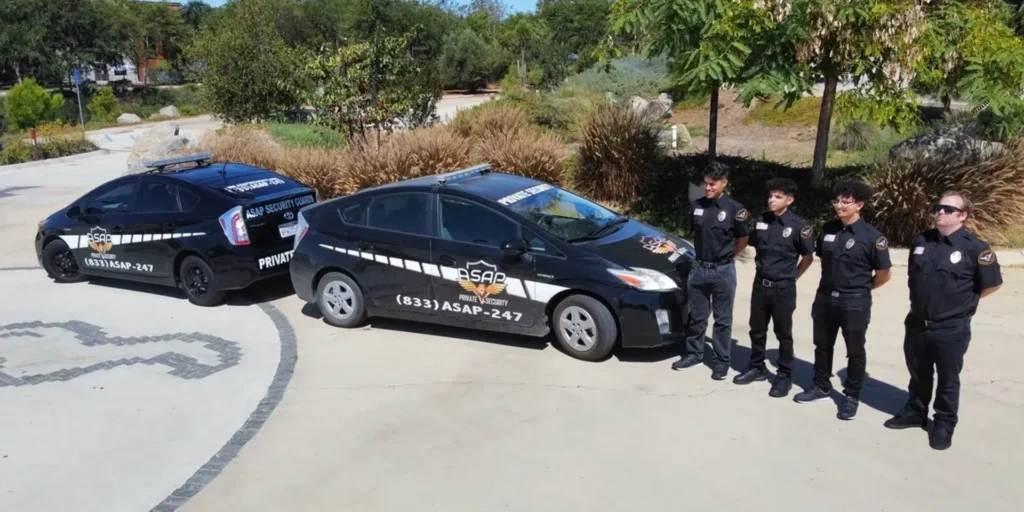
A security program should begin with the site you actually operate, not a generic list of services. A healthcare facility, manufacturing plant, hotel, office campus, and managed property each have different people, assets, routines, access points, and operating constraints.
Call (833) 272-7247 to discuss your property’s security assessment needs.
A security risk assessment is a structured review of threats, vulnerabilities, controls, and site conditions that helps decision-makers plan practical safeguards. It turns observations into priorities, documented responsibilities, and deployment choices rather than assuming every location needs the same coverage. This approach aligns with NIST’s Guide for Conducting Risk Assessments.
For buyers in San Diego, Orange, Riverside, and San Bernardino counties, the value is a clearer path from concern to action. The first step is understanding what the assessment examines and how it differs from a general guard-service overview.
What Is a Security Risk Assessment for a Business?
A security risk assessment is a structured review of a business site, its people, assets, operations, and existing safeguards. It identifies relevant threats and vulnerabilities, then organizes the findings so leaders can make practical decisions about security priorities. The result is not simply a list of problems. It is a planning document that supports decision-making, risk management, and the allocation of people, technology, and budget where they can provide the most value. Industry risk-management guidance describes the assessment as a tool for decision-making, planning, and risk management.
For a business buyer, the assessment creates a common factual basis for conversations among executives, facility managers, property managers, operations teams, and security providers. It can clarify which entrances need controlled access, where visibility is limited, how employees or visitors move through the site, and which procedures need stronger ownership or documentation. It can also surface risks that are easy to overlook when attention is focused only on a building’s front door.
What does the assessment examine?
The scope depends on the site and the business, but a sound review considers more than guard coverage. It may examine the property layout, access points, visitor management, lighting, cameras, emergency procedures, employee awareness, incident history, critical equipment, and areas that are empty after hours. For organizations with multiple locations, the review may include off-site facilities and differences in how each property operates.
Physical security planning can also intersect with supporting utilities, system reliability, and contingency planning. The National Institute of Standards and Technology’s physical security guidance addresses security analysis alongside natural disasters, supporting utilities, and system reliability. These considerations help a buyer ask whether a security plan remains workable during an interruption, evacuation, severe weather event, or other operational disruption.
How is it different from a guard-service overview?
A guard-service overview explains available service models, such as standing posts or mobile patrols. An assessment comes first: it explains why a particular combination may fit a specific property and what that deployment is expected to address. The NIST Guide for Conducting Risk Assessments provides a recognized reference point for risk-assessment methodology, while the final recommendations should still reflect the site’s conditions, operations, and priorities.
That distinction matters in Southern California, where a commercial office, warehouse, healthcare facility, hotel. Or managed property may require a different balance of access control, patrol visibility, reporting, training, and response coordination. A business can then evaluate corporate security services against documented needs instead of choosing coverage based on a generic package.
How Does a Security Risk Assessment Work?
A useful assessment is a structured planning exercise, not a quick walk-through followed by a generic guard proposal. The reviewer gathers site information, tests assumptions against actual conditions, and turns observations into prioritized actions. NIST’s Guide for Conducting Risk Assessments provides a recognized reference point, but a private security assessment should be adapted to the property’s operations, people, assets, and risk tolerance.
The following five-step model keeps the process practical. It can be applied to an office, warehouse, healthcare facility, multifamily property, event venue, or a portfolio spanning several Southern California locations.
- Define the scope and inventory the assets. Start by agreeing on what the assessment covers and what decision it needs to support. Map buildings, entrances, parking areas, loading zones, restricted rooms, public spaces, tenant areas, and any off-site facilities. Identify the assets that matter, including employees, visitors, residents, equipment, inventory, sensitive information, and business operations. Document operating hours, shift changes, occupancy patterns, deliveries, contractors, and existing security coverage. A clear scope prevents the review from focusing only on the front entrance while overlooking a remote gate, shared parking area, or critical utility.
- Identify threats and vulnerabilities. Review credible threat sources and the conditions that could make an incident more likely or more disruptive. That may include unauthorized access, theft, vandalism, workplace conflict, crowd-related problems, fire, severe weather, utility failure, or a loss of communications. Then examine vulnerabilities in physical design, access procedures, staffing, lighting, cameras, locks, visitor management, emergency procedures, and employee security awareness. NIST’s physical security guidance includes procedural measures and controls, supporting utilities, natural disasters, and system reliability, so the review should extend beyond doors and fences. Record what was observed, where it was observed, and what evidence supports the finding.
- Evaluate likelihood and impact. Consider how plausible each threat is under the site’s actual conditions and what the consequence would be if it occurred. Impact may involve injury, interruption, property loss, privacy concerns, reputational harm, or delayed operations. This does not require false precision or a universal scoring formula. A simple high, medium, or low scale can work when the definitions are documented and applied consistently. Separate an existing control from an assumed control, and note uncertainty where more information is needed.
- Prioritize controls and practical responses. Rank findings by urgency, potential consequence, exposure, and the feasibility of improvement. Recommendations may include a procedure change, access-control adjustment, lighting or camera improvement, staff training, a standing guard, or mobile patrol coverage. The right response depends on site conditions and should address the underlying vulnerability rather than add security for its own sake. For a large or multi-site property, patrol routes and checkpoint documentation may be more useful than identical coverage at every location.
- Document ownership and follow-up. Finish with a report that connects each priority to an owner, action, sequence, and review date. Include unresolved questions, assumptions, evidence, and contingency plans. A follow-up audit can test whether controls were implemented and whether they work as intended. NIST includes security audits and contingency plans among relevant physical security topics. This reinforces that an assessment is a decision tool that should be revisited when operations, occupancy, facilities, or threats change.
This approach gives leaders a defensible basis for choosing next steps without treating the assessment as a rigid legal standard. It also creates a shared working document for facility teams, security personnel, and management.
What Vulnerabilities Should the Assessment Examine?
A useful assessment looks beyond doors, cameras, and guard posts. It examines how people, spaces, procedures, and supporting systems work together during ordinary operations and under stress. NIST physical-security guidance identifies security analysis, natural disasters, supporting utilities, system reliability, procedural controls, off-site facilities, contingency plans, security awareness, and security audits as relevant considerations. Those categories provide a practical framework for reviewing a commercial or multi-site operation without assuming that every property has the same exposure.
People, behavior, and awareness
The review should consider who enters the property, who can authorize access, and how employees, contractors, tenants, visitors, and delivery personnel are identified. It should also examine whether staff know how to challenge an unknown person, report a concern, respond to an alarm, and follow escalation procedures. Security awareness is not a substitute for physical controls, but it can reveal gaps between written policy and daily behavior. Interviews, observation, training records, and incident reports can help show whether expectations are understood and consistently applied.
Perimeters, access points, and interior zones
Inspect the full perimeter, not only the main entrance. The assessment should review gates, loading areas, parking lots, service doors, windows, rooftops, lighting, fencing, and areas hidden from normal observation. Inside the facility, separate public, employee, restricted, storage, server, medication, cash-handling, and other sensitive zones. Consider how credentials are issued and revoked, how visitors are escorted, and what happens after hours. A vulnerability may be a design feature, such as an unobserved side entrance, or a process failure, such as access that remains active after a role changes.
Procedures, utilities, and continuity
Document the procedural measures and controls that govern opening and closing, key management, deliveries, alarms, investigations, and emergency communications. Then test how the site would function if a supporting utility or security system became unavailable. NIST specifically includes supporting utilities and system reliability in its physical-security framework. Review power, communications, access-control systems, surveillance, fire and life-safety coordination, and backup arrangements. Contingency plans should identify decision-makers, alternate methods, and priorities for protecting people and critical assets during a disruption or natural disaster.
Off-site facilities and evidence
For organizations operating warehouses, remote offices, parking areas, clinics, or other locations, include off-site facilities in the same risk picture. Compare standards across locations and identify handoff points where responsibility may be unclear. Finally, examine the evidence used to manage the program: audit findings, visitor logs, patrol records, training documentation, alarm history, corrective actions, and incident reports. NIST includes security audits among its relevant topics. Reliable evidence lets leaders distinguish an isolated observation from a recurring vulnerability and assign a practical next step.
These findings should remain specific to the site and its operating model. The objective is not to label every weakness as urgent, but to give decision-makers enough documented context to prioritize controls and select an appropriate response.
How Priorities Change by Industry and Property Type
A useful assessment starts with the operation, not a preselected guard post. The same access point can represent a visitor-management issue at an office, a production-continuity issue at a factory, or a patient-safety concern at a healthcare facility. Buyers should expect the assessor to connect observed conditions to the people, assets, processes, and service obligations that matter most at that site.
| Property or industry | Assessment priorities | Questions for the buyer |
|---|---|---|
| Commercial offices | Visitor control, employee and tenant communication, after-hours access, parking areas, and incident documentation. | Who can enter after normal business hours? How are visitors, vendors, and incidents recorded? |
| Manufacturing and warehouses | Protection of people, equipment, inventory, loading areas, perimeter access points, and operational continuity. | Which materials or processes are most sensitive to loss, unauthorized access, or an interruption? |
| Healthcare facilities | Workplace violence concerns, patient privacy, emergency departments, de-escalation capability, and coverage across clinical areas. | Where do staff need controlled access, conflict support, or a clearly documented escalation path? |
| Hospitality and events | Guest safety, access management, crowd movement, VIP protection, emergency response, and pre- and post-event coordination. | How will the plan change with attendance, venue layout, alcohol service, or elevated guest visibility? |
| Property management | Tenant or resident safety, common areas, parking, vacant units, service entrances, patrol coverage, and communication with occupants. | Which recurring conditions require observation, access control, patrols, or faster management reporting? |
Commercial office findings often center on predictable movement and accountability. A buyer may need to examine lobby procedures, badge or key control, deliveries, tenant concerns, and evening coverage. For additional context, see this guide to office building security planning. A broader commercial property security review can also help managers frame parking, tenant, and perimeter observations, but the assessment should still reflect the actual building.
Manufacturing assessments must follow the flow of work. Loading docks, contractor access, inventory storage, restricted production zones, and remote or poorly observed areas may deserve different controls. Healthcare requires a similarly operational lens, but the consequences of a disruption can involve patients, staff, visitors, and sensitive information. The assessment should identify where trained personnel, procedures, and escalation support are needed without treating a security service as a substitute for clinical or regulatory responsibilities.
Hospitality priorities can change by shift, occupancy, event schedule, and venue configuration. Property managers may need a portfolio view that compares recurring issues across multiple buildings, parking areas, and common spaces. A multifamily property security resource is useful when the portfolio includes residential communities.
Call (833) 272-7247 to review assessment findings with a Southern California security team.
These differences affect the final buying decision. The result may be standing coverage, mobile patrols, access procedures, training, reporting, or a combination, but no deployment should be automatic. Ask for recommendations tied to specific observations, priority levels, responsible owners, and measurable follow-up. That turns a security risk assessment into a practical decision document rather than a generic description of guard services.
Turning Findings Into a Practical Security Plan
An assessment is useful only when its findings guide decisions people can implement. The recommendation should connect each material vulnerability to a control, responsible owner, and review point. That may mean changing a procedure, improving visibility at an entrance, scheduling trained personnel, or coordinating several measures rather than selecting a single service by default.
Match coverage to the site and the risk
Standing guards can make sense when a property needs a consistent presence at a lobby, gate, loading area, or other defined post. In a standard commercial setting, an unarmed officer may handle access control, visitor management, incident reporting, and visible deterrence. The assessment should define the post orders, hours, handoff process, escalation path, and records the officer is expected to maintain.
Armed coverage is a narrower recommendation, not an automatic upgrade. It may be considered where documented conditions justify a higher level of protection, such as a higher-risk environment or especially valuable assets. The provider and client should separately review the legal, training, permitting, insurance, and operational requirements before selecting that model. If the findings do not support it, unarmed coverage and stronger procedures may be the more appropriate fit.
Use patrols and access controls to close coverage gaps
Mobile patrols can extend oversight across large properties, parking areas, or multiple locations without placing a guard at every point continuously. The plan should identify the areas to visit, the checkpoints to verify, the conditions that require escalation, and how patrol activity will be documented. GPS-tracked routes, randomized timing, and photo-verified, time-stamped checkpoints can create a practical record of what was inspected and when.
Access control recommendations may include visitor sign-in, credential checks, delivery procedures, lock and gate management, camera monitoring, or a clearer after-hours protocol. These controls should align with how employees, tenants, contractors, and emergency personnel actually move through the site. A control that is difficult to follow will not remain reliable during a busy shift.
Build training, dispatch, and emergency coordination into the plan
Training should address the site-specific duties identified in the assessment, including communication, de-escalation, reporting, access procedures, and emergency responsibilities. Written post orders and supervisor reviews help turn expectations into repeatable practice. For organizations comparing broader corporate security services, ask how training and supervision will reflect the facility’s operations rather than relying on a generic assignment.
A practical plan also names who receives an alert, who contacts the client, and when emergency services are involved. ASAP operates a 24/7 human dispatch center that coordinates among guards, clients, and emergency services. That capability can support the communication structure, but the assessment should still document roles, contact information, escalation criteria, and reassessment triggers. The result is an accountable security program tied to observed conditions, not a list of services detached from the site’s needs.
What Should the Final Assessment Report Include?
A useful report turns an on-site review into a decision document. It should help an executive understand the most important exposures, help a facility manager act on them. And give the security team a baseline for checking whether controls are working. The report should be specific to the property, people, operations, and service area reviewed rather than a generic security-guard overview.
Executive summary and assessment scope
Open with a concise executive summary that identifies the assessment objective, the overall risk picture, and the decisions requiring attention. Then document the scope: locations visited, buildings and outdoor areas examined, operating hours considered, stakeholders interviewed, and assets included. If a company has multiple sites, clearly identify which facilities were reviewed and which were outside the assessment. This prevents readers from treating a site-specific conclusion as a system-wide finding.
Risk register with supporting evidence
The core of the report should be a risk register. For each finding, describe the condition observed, the asset or operation affected, the likely consequence, and the factors that increase or limit exposure. Assign a priority using a consistent method, and explain the reasoning in plain language. Supporting evidence may include interview notes, photographs, access-point observations, incident records, policy reviews, and relevant site data. A finding without evidence is difficult to validate or assign.
The report should also review procedural measures, contingency plans, supporting utilities, and system reliability where they affect physical protection. NIST identifies security audits as part of physical security guidance, which reinforces the value of documenting how findings were verified and how they can be reviewed later: NIST physical security guidance.
Prioritized recommendations and ownership
Recommendations should connect directly to findings. Separate immediate actions from near-term improvements and longer-term projects. Each item should name an accountable owner, required dependencies, a target completion window, and a measure of completion. Depending on site conditions, actions might include revising visitor procedures, improving access control, adding patrol checkpoints, adjusting post instructions, or reviewing emergency coordination. The assessment should not assume that guards, technology, or any single control is appropriate for every property.
For buyers evaluating a provider, the supporting file can also list requested documentation. Such as licensing and insurance information, without presenting those documents as proof that every risk has been resolved. A reporting example should show how service activity will be recorded. GPS-enabled daily activity reports can provide time-stamped, photo-documented proof of service for accountability and audit needs.
Reassessment triggers
Close with review criteria and triggers for reassessment. Schedule a follow-up after major construction, a change in occupancy or operating hours, a new access system. An incident or near miss, a material change in staffing, or expansion to another site. A final report is most valuable when it becomes a maintained risk record, not a static file that is archived after delivery.
How Should Southern California Buyers Compare Providers?
A polished proposal is not enough to evaluate a security provider. Compare the provider’s ability to understand your site, document its work, communicate clearly, and adjust deployment as conditions change. A useful checklist should help a facility manager or property leader compare operating capability, not just service labels.
Look for relevant experience and documented qualifications
Ask whether the provider has worked with properties similar to yours. A warehouse, healthcare campus, office building, gated community, and event venue can have very different access points, reporting needs, and escalation procedures. The provider should be able to explain how it would examine your people, assets, operating hours, visitors, vulnerable areas, and off-site locations.
Request licensing and insurance documentation before moving forward. These are basic vendor-evaluation items, along with clear information about supervision, training, and who will be accountable for the account. A security vendor evaluation checklist commonly includes patrol coverage, access control, reporting, licensing, and insurance requirements. So these should be easy for a serious provider to explain and substantiate (security vendor evaluation checklist).
Test reporting, dispatch, and communication
Ask to see a sample report with sensitive details removed. It should make clear what was checked, when it was checked, what was observed, and what action followed. GPS-enabled activity reporting with time-stamped and photo-documented proof can make service more accountable, particularly for large sites or multiple locations.
Clarify how routine questions, incidents, schedule changes, and emergencies are handled. Find out who receives reports, who can authorize a change, and whether dispatch coordinates directly with guards, clients, and emergency services. Communication should be specific enough that your team knows what happens after a finding is identified, rather than relying on vague promises about responsiveness.
Confirm geographic fit and deployment flexibility
For Southern California operations, geographic coverage matters when a provider must support more than one facility. ASAP serves San Diego, Orange, Riverside, and San Bernardino counties. Ask how the proposed team will maintain consistency across your locations and how local supervision will work.
Finally, compare whether the provider can scale from a single guard to a larger deployment when site conditions or business needs change. That may involve unarmed coverage, vehicle patrols, access control, reporting, or other measures. The right recommendation should follow the security risk assessment, not a preset package. Ask the provider to translate its findings into a phased plan with clear responsibilities, review points, and practical next steps. For a broader view of available models, review corporate security services alongside the assessment itself.
Frequently Asked Questions
What are the five steps of a security risk assessment?
Start by defining the assessment scope and business priorities. Next, inventory people, property, information, operations, and critical access points. Review relevant threats and vulnerabilities through interviews, site observation, and document review. Prioritize risks by potential impact and likelihood. Finally, produce a documented action plan that assigns recommendations, owners, and an implementation sequence.
What is an example of a security risk assessment?
For a Southern California distribution facility, an assessment might review employee entrances, visitor procedures, loading docks, inventory areas, parking, lighting, camera coverage, after-hours activity, and emergency communication. The report could then recommend improved access control, scheduled or mobile patrols, staff training, and clearer incident reporting, depending on the evidence found at that site.
How often should a business conduct a security risk assessment?
There is no universal schedule for every property. Reassess after a significant incident or near miss, a major change in operations, a new location. A renovation, a change in occupancy, or a new concern from employees or tenants. Regular reviews and security audits can also confirm whether controls remain practical as conditions change. NIST includes security audits among the subjects addressed in its physical security guidance: NIST physical security guidance.
What should a buyer receive after the assessment?
Request an executive summary, documented observations, a prioritized risk register, supporting evidence, recommended controls, and a practical implementation sequence. The deliverable should explain why each recommendation fits the site, who owns the next action, and how results will be verified. It should also identify triggers for reassessment rather than treating the report as a one-time sales document.
Ready to Plan Your Security Risk Assessment?
A focused assessment can help your team turn site conditions, operational concerns, and documented vulnerabilities into practical protection priorities. The right next step depends on your property, people, and daily activities across Southern California. Call ASAP Security Guards at (833) 272-7247 to discuss a security risk assessment and practical protection plan.
