
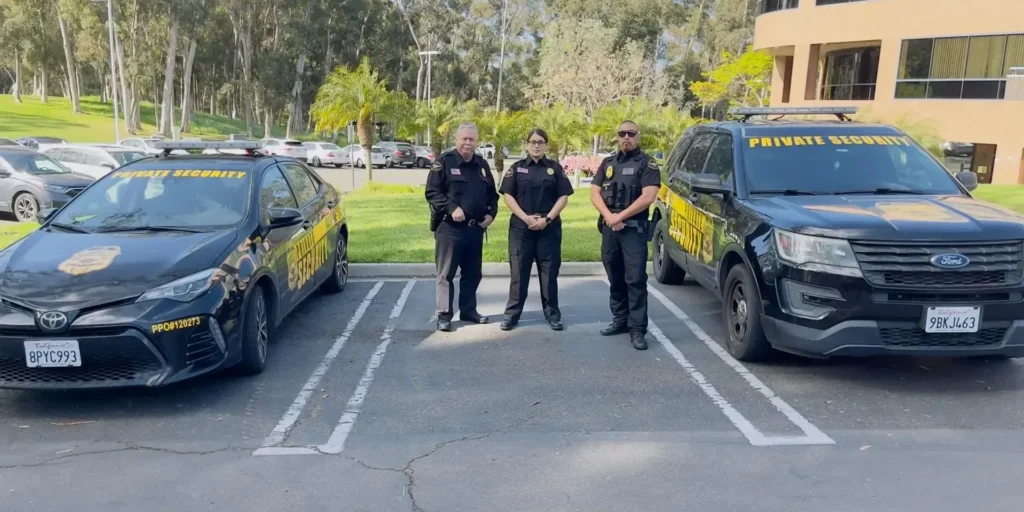
Commercial parking lots across Southern California face changing conditions throughout the day. Employees, residents, customers, and visitors may share the same entrances, garages, and walkways, while poor lighting and limited visibility can create opportunities for theft, vandalism, and unauthorized access. A visible, trained presence helps property managers address risks before they become costly incidents.
Call (833) 272-7247 to discuss a security plan for your property.
Parking lot security guards deter theft, vandalism, and unauthorized access by maintaining a visible presence, monitoring activity, and responding to developing concerns. For commercial properties, coverage can be scheduled around peak traffic, evening operations, or other higher-risk periods.
The right approach depends on the property layout, operating hours, and the threats most likely to affect people and assets. Understanding those risks is the first step toward choosing practical coverage for a Southern California site.
Parking Lot Security Guards: Common Parking Lot Security Threats in Southern California
Parking areas can become vulnerable points for commercial properties, apartment communities, shopping centers, and office campuses. The risks are not limited to a single type of incident. A poorly monitored lot may invite theft, vandalism, vehicle break-ins, loitering, or unauthorized access to buildings and restricted areas. In Southern California, property managers also need to account for changing traffic patterns between daytime business hours and evening operations.
Theft, vandalism, and vehicle break-ins
Cars left unattended create opportunities for window smashing, stolen property, catalytic-converter theft, and other vehicle-related crimes. Vandalism can include damage to parked vehicles, lighting, gates, signs, or loading-area equipment. These incidents affect more than the immediate repair bill. Employees and customers may feel unsafe returning to their vehicles, while repeated problems can damage a property’s reputation.
Commercial properties should pay particular attention to the hours when natural observation is lowest. Available safety guidance indicates that a significant majority of vehicle-related crimes in commercial parking lots take place during evening or night hours, which makes specialized coverage important. Review workplace violence and safety guidance from the CDC and NIOSH when assessing lighting, visibility, staffing, and response procedures.
Loitering and unauthorized access
Loitering may begin as an apparently minor concern, but it can create blocked walkways, confrontations, noise complaints, or opportunities for trespassing. Unauthorized people may also enter employee-only areas, access delivery zones, follow residents through controlled entrances, or use a commercial lot for activities unrelated to the property. These situations require a calm, consistent response that protects people without unnecessarily escalating an encounter.
Uniformed security guards are highly effective at deterring criminal activity such as theft, vandalism, and unauthorized access in parking lots. A visible officer can monitor entrances, walk the property, identify unusual behavior, and document incidents while they are developing. This presence is especially useful when cameras or access systems identify a concern but cannot assess the situation or intervene in person. Retail security parking lot coverage can help shopping centers coordinate patrols around customer entrances, storefronts, and high-traffic areas.
Apartment communities face a related mix of resident safety, visitor management, and vehicle security concerns. A tailored commercial parking lot security plan for apartment communities can address garage access, guest activity, after-hours patrols, and communication with property management. The right coverage should reflect the property’s layout, peak activity, lighting conditions, and history of incidents rather than relying on a one-size-fits-all schedule.
Mobile Patrol vs. Standing Guard: Which Is Right for Your Property?
Parking lot security guards can provide either a visible, stationary presence or a moving patrol that checks multiple areas on a schedule. The right choice depends on the property’s layout, operating hours, traffic patterns, and risk profile. Many Southern California properties use a blended plan, pairing patrols with access control, cameras, lighting, and clear incident procedures.
For context, Owlsight Security ranks #2 for this keyword with a short Southern California-focused page. A more useful decision comes from comparing how each coverage model functions on the ground.
| Factor | Mobile patrol | Standing guard |
|---|---|---|
| Visibility | Marked vehicles and recurring rounds create a moving security presence across entrances, parking rows, loading areas, and perimeter points. The changing location can make it harder for unauthorized activity to go unnoticed. | A uniformed officer remains at a designated entrance, lobby, gate, or high-priority zone. This offers immediate visibility to drivers, employees, residents, and visitors who pass that point. |
| Deterrence effectiveness | Regular checks can discourage theft, vandalism, loitering, and unauthorized access in several parts of a property. Patrols are especially useful when a site has multiple lots or a broad perimeter. | A constant presence can deter incidents in one concentrated area and gives people a clear point of contact for assistance, directions, access questions, or reporting a concern. |
| Cost profile | Usually offers broader geographic coverage with fewer continuously staffed hours. It can be a practical fit for businesses that need scheduled checks rather than a dedicated officer at one post. | Requires dedicated staffing for the assigned post and shift. The higher continuous coverage investment may be justified where traffic, access control, or customer safety requires an officer on site. |
| Response time | Response depends on the patrol route, dispatch process, and officer location when an incident is reported. Set checkpoints, radio communication, and escalation procedures help keep response consistent. | The officer can respond immediately within the assigned area and escalate to supervisors, emergency services, or property management when appropriate. |
| Ideal property types | Multi-site portfolios, business parks, industrial properties, construction areas, large shopping centers, and lots where perimeter visibility matters. See options for parking lot security guards for multi-site properties. | Hospitals, busy retail centers, residential communities, gated facilities, event venues, and properties with a controlled entrance or a consistently busy pedestrian area. |
When a blended plan makes sense
Mobile patrol and standing coverage do not have to be competing choices. Human patrols provide real-time threat assessment and response that automated access control systems cannot replace, according to ASAP Security Guards’ training resources. A facility may place a standing officer at its primary entrance during peak hours, then use mobile rounds to check secondary lots and perimeter areas overnight. Review the differences in mobile patrol vs. standing guards with a security professional before selecting a schedule.
How Security Guards Improve Customer Confidence and Property Value
A visible, uniformed officer changes how people experience a parking area. Shoppers, employees, residents, and visitors are more likely to feel comfortable arriving at, walking to, or returning to a vehicle when trained personnel are actively monitoring the property. That visible presence can discourage theft, vandalism, and unauthorized access before an incident develops.
A stronger sense of safety for customers and tenants
Confidence is shaped by what people can see. Regular foot or vehicle patrols, attentive entry and exit monitoring, and a clear response process show that property management takes safety seriously. For retail centers, this can make the parking experience feel less stressful. For apartment communities, reliable coverage can reassure residents and support tenant satisfaction, especially during evening hours.
Coverage should match the property rather than rely on a one-size-fits-all schedule. Property managers comparing options can review commercial parking lot security for apartment communities when evaluating patrol patterns, staffing, and site-specific needs.
Documented prevention supports liability mitigation
Security cannot eliminate every accident or crime, but a professional program creates a practical safety layer. Property owners can mitigate liability by demonstrating a commitment to safety through the deployment of professional, licensed parking lot security guards, according to the National Institute of Justice. Officers can identify hazards, report suspicious activity, enforce access policies, and escalate incidents promptly. Consistent incident documentation also gives management a clearer record of what was observed and how the team responded.
Protecting the property experience and long-term value
Clean, well-managed parking areas contribute to the overall impression of a commercial or residential property. A recurring pattern of theft, vandalism, or poorly handled safety concerns can affect tenant relationships and make prospective customers or occupants hesitate. By helping prevent avoidable incidents and responding visibly when concerns arise, guards support tenant retention and protect the property’s reputation. That operational consistency can help preserve occupancy, customer trust, and the long-term value of the asset.
What to Look for in a Parking Lot Security Company
Choosing a parking lot security company involves more than comparing hourly rates. Property managers should confirm that the provider is properly licensed, trains officers for the assignment, communicates incidents clearly, and can maintain reliable coverage across the local service area. These standards help ensure that a visible presence is also a capable and accountable one.
Confirm BSIS licensing and professional training
In California, all private security personnel must be registered and licensed through the Bureau of Security and Investigative Services (BSIS). Ask the company how it verifies each officer’s license before assignment and how it monitors renewals. A reputable provider should be able to explain its screening and onboarding process without hesitation.
Training should also match the conditions officers will face on your property. Parking lot personnel may need to identify suspicious behavior, respond calmly to disputes, document incidents, and coordinate with emergency services. Ask whether officers receive ongoing instruction rather than only the minimum preparation required for placement. ASAP Security Guards provides officer training through its online Academy, including training aligned with the needs of professional security work.
Evaluate reporting and communication systems
Incident reporting is an important measure of operational quality. Look for a company that provides real-time reporting, clear incident details, time stamps, and reliable communication with property management. Reports should help you understand what happened, what action the officer took, and whether a recurring problem requires a change in lighting, access control, patrol timing, or staffing.
Technology should support officers, not replace sound judgment. Cameras, gates, and other automated access control tools can alert a team to activity, but human patrols remain important for real-time threat assessment and response. A strong provider should explain how its officers use available systems while maintaining an active presence throughout the lot.
Check local coverage and language capability
Choose a company that understands the operating conditions in Southern California and can provide dependable supervision in the communities where you own or manage property. Local familiarity can support better scheduling, faster coordination, and more practical recommendations for sites in Los Angeles, San Diego, Orange County, Riverside, San Bernardino, and Ventura.
Finally, ask whether bilingual Spanish-English personnel are available when your tenants, employees, customers, or vendors need them. Clear communication can reduce misunderstandings and make officers more approachable. Before signing, request a sample report, confirm the escalation process, and verify who will supervise the account.
Protect Your Southern California Property with Professional Parking Lot Security
Parking lot protection works best when it matches the property, its operating hours, and the people who use it. ASAP Security Guards provides dependable coverage for commercial properties throughout San Diego, Los Angeles, Orange County, Riverside, San Bernardino, Ventura, and the surrounding Southern California region. Property managers can request a visible patrol presence, scheduled checks, or a standing post based on the lot’s layout and risk profile.
Our BSIS-licensed security guards help deter unauthorized access, theft, vandalism, and other disruptions before they affect tenants, employees, customers, or visitors. Officers can monitor activity around entrances, pedestrian paths, loading areas, and isolated sections of a property. A consistent professional presence also gives property teams a practical point of contact when conditions change or an incident requires immediate attention.
Coverage that supports different property needs
Retail centers, office buildings, apartment communities, industrial sites, and mixed-use properties do not face identical parking lot concerns. ASAP can help evaluate when a mobile patrol, standing guard, or combination of services makes the most sense. For Orange County property managers, our security guard services for commercial properties provide a focused starting point for planning coverage.
Human observation remains important even when a property uses cameras, gates, lighting, or other access controls. Automated systems can alert a team to activity, while trained officers assess the situation in real time, communicate with the appropriate contacts, and document what occurred. ASAP’s real-time incident reporting helps property managers maintain a clear record and make informed adjustments to their security plan.
Clear communication for Southern California communities
Security is more effective when officers can communicate comfortably with the people they serve. ASAP offers bilingual Spanish and English personnel, helping support diverse tenants, customers, employees, and vendors across the region. To discuss parking lot security guards for your property, call (833) 272-7247 or request a consultation with ASAP Security Guards.
For a broader plan covering entrances, common areas, and other property risks, review our corporate security services.
Frequently Asked Questions
What should parking lot security guards do during a typical shift?
They should maintain visible patrols, monitor entrances and exits, identify suspicious activity, support customers and employees, and document incidents. Duties can also include checking lighting concerns, observing loading areas, enforcing property rules, and promptly escalating emergencies according to the site’s procedures.
Are mobile patrols or standing guards better for a commercial parking lot?
The right choice depends on the property’s layout, operating hours, risk profile, and need for a constant point of contact. A standing guard provides a consistent visible presence at a gate, lobby, or high-traffic area. Mobile patrols cover more space and can be scheduled at changing intervals. Some properties use both approaches for layered coverage.
Can security guards help reduce theft and vandalism in parking areas?
Yes. Uniformed visibility can deter theft, vandalism, unauthorized access, and other disruptive behavior. Guards can also spot concerns early, assist with incident response, preserve useful details for management and create reliable reports that help property owners adjust lighting, access, and patrol plans.
What credentials should a California parking lot security company have?
Ask whether assigned officers are properly licensed through California’s Bureau of Security and Investigative Services, or BSIS, and whether the company maintains appropriate insurance. A strong provider should also offer documented training, supervisor oversight, real-time incident reporting, and clear communication procedures. BSIS licensing is required for private security work in California. California BSIS
Is parking lot security needed after business hours?
Evening and nighttime coverage can be especially important because many vehicle-related crimes occur during those hours. A provider can review closing times, tenant schedules, lighting, access points, and prior incidents to recommend standing coverage, mobile patrols, or a combination that fits the property’s actual exposure. CDC/NIOSH workplace violence resources
Ready to Improve Parking Lot Security?
A well-planned security presence can help commercial property owners address common parking lot concerns and create a more welcoming environment for tenants, customers, and employees. Schedule a free consultation to discuss professional coverage for your Southern California property. Call (833) 272-7247 to talk with the ASAP Security Guards team about the next step.
