
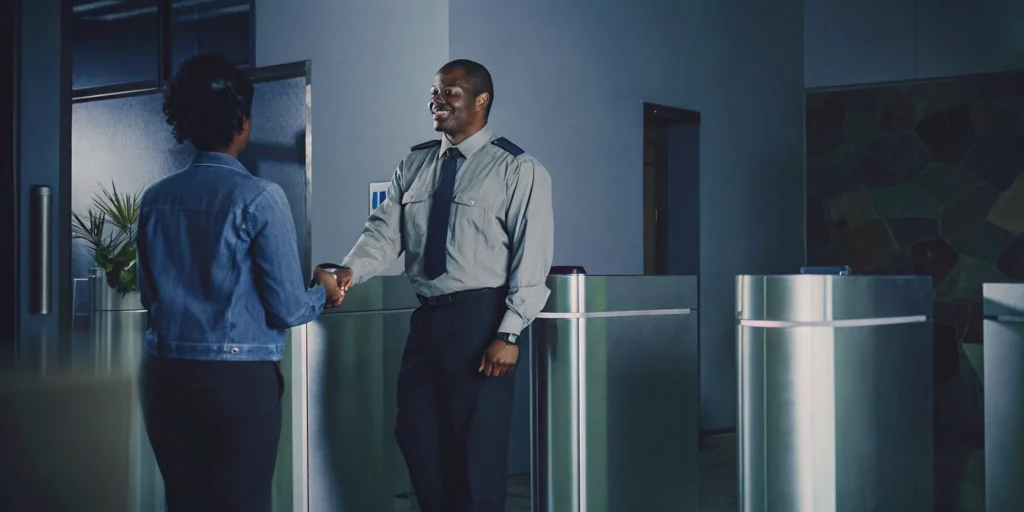
A visitor arrives for a 10 a.m. meeting, a delivery driver is waiting at the side entrance, and an employee reports a former vendor in the parking lot. These are ordinary moments until nobody owns the response. Office security guards give workplaces a trained person who can verify access, notice unusual activity, document concerns, and act when a routine interaction changes.
Request an office security quote from ASAP Security Guards to build coverage around your workplace, visitor volume, operating hours, and risk profile.
Office security guards protect workplaces by controlling entry, screening visitors, monitoring shared areas, responding to incidents, and documenting activity. Unlike a receptionist or camera system alone, an on-site guard can make a judgment. Communicate a boundary, and take immediate action while helping employees and approved visitors feel welcome.
The right assignment is not a generic officer standing by a door. It is a defined operating plan that connects the lobby, loading areas, parking access, after-hours entry, emergency procedures, and management reporting. This guide explains how that plan works and what decision-makers should evaluate before hiring guard coverage.
What office security guards do in a modern workplace
An office guard’s duties should reflect how the building actually operates. A professional services office with scheduled clients needs a different post plan than a shared corporate campus with vendors, late-shift teams, and several controlled entrances. The assignment begins with post orders: written instructions that define where the guard works, who may enter, what requires escalation, and how every incident is recorded.
Manage reception and access control
At the main entrance, a guard can confirm appointments, check identification, issue visitor credentials, contact hosts, and prevent tailgating through controlled doors. This creates a consistent process even when reception staff are busy or absent. When someone does not meet the entry requirements. The guard can keep the conversation at the access point rather than allowing the issue to move deeper into the workplace.
Monitor common areas and vulnerable access points
Regular patrols extend coverage beyond the lobby. Guards check doors, stairwells, parking access, shared corridors, and other areas selected during the site assessment. The purpose is not simply to walk a route. It is to identify conditions that are out of place, such as a propped door. An unfamiliar person in an employee-only area, or a package left where it does not belong.
Respond, document, and escalate
When an incident occurs, the guard follows the site’s response plan. That may mean separating people during a dispute, calling emergency services, directing employees away from a hazard, or preserving information for management. Clear incident notes help workplace leaders understand what happened and decide whether policies, staffing, or access procedures need to change.
How do guards improve visitor control and access management?
Visitor control fails when different employees apply different rules. One person may escort every guest, while another may hold a secure door for someone who looks familiar. A trained guard makes the process consistent and visible. That consistency reduces confusion for employees, approved visitors, vendors, and delivery personnel.
Separate visitor types before they enter
A practical visitor plan distinguishes among scheduled guests, unscheduled guests, contractors, delivery drivers, and former employees or vendors. Each group can have its own verification and escort requirements. A courier may be directed to a package area, for example, while a repair contractor may need both host approval and a temporary credential.
Use a clear exception process
The most important part of an access plan is what happens when the normal process does not work. If a host cannot be reached, the guard should know whether to ask the visitor to wait, call a designated backup, or deny entry. If a credential does not scan, the guard needs a reliable way to verify the person without simply waving them through.
- Confirm the visitor’s identity and reason for arrival.
- Verify the appointment or contact an authorized host.
- Issue the correct credential and explain access limits.
- Arrange an escort when required by the site policy.
- Record arrival and departure according to the post orders.
- Escalate exceptions instead of improvising access.
This process should support the business rather than create a cold or confrontational lobby. The strongest office guards combine firm boundaries with professional communication.
Visible deterrence and faster workplace response
A uniformed guard changes the environment before an incident occurs. People entering the building can see that access rules are being enforced and activity is being observed. Employees also know where to report a concern without searching for the right manager during a stressful moment.
Deterrence is most effective when it is active. A guard who greets people, varies patrol timing, checks vulnerable areas. And follows up on irregular activity is more valuable than someone who remains at a desk without engaging the site. For Southern California offices with parking lots, shared lobbies, or multiple tenants, this active presence can connect spaces that otherwise operate as separate security gaps.
A practical response scenario
Consider a former contractor who arrives and says a manager invited them to collect equipment. The guard does not need to assume bad intent, but should not accept the story without verification. Following the post orders, the guard keeps the person in a public waiting area. Contacts an authorized manager, records the interaction, and denies access if approval cannot be confirmed. This calm process protects the office without turning every unusual arrival into a crisis.
Review ASAP Security Guards’ Southern California security services for commercial properties that need professional on-site protection.
Office guards, reception staff, and cameras compared
Receptionists, cameras, electronic access systems, and guards each solve a different part of the security problem. They are most effective when responsibilities are clear and the tools support one another.
| Resource | Primary strength | Important limitation |
|---|---|---|
| Office security guard | Can assess a situation, enforce policy, respond, and document | Needs clear post orders, supervision, and site-specific training |
| Reception staff | Provides hospitality, scheduling support, and general assistance | May not be trained or positioned to manage threats and confrontations |
| Security cameras | Provides visibility and recorded evidence across selected areas | Cannot physically intervene or question someone at the door |
| Electronic access control | Restricts doors based on approved credentials | Cannot reliably prevent tailgating or interpret unusual behavior |
A guard can connect these systems. For example, the guard can review a camera alert, meet the person at the relevant entrance, verify their purpose, and document the result. The goal is not to replace workplace technology or reception teams. It is to close the gap between noticing a concern and acting on it.
When should an office consider professional guard coverage?
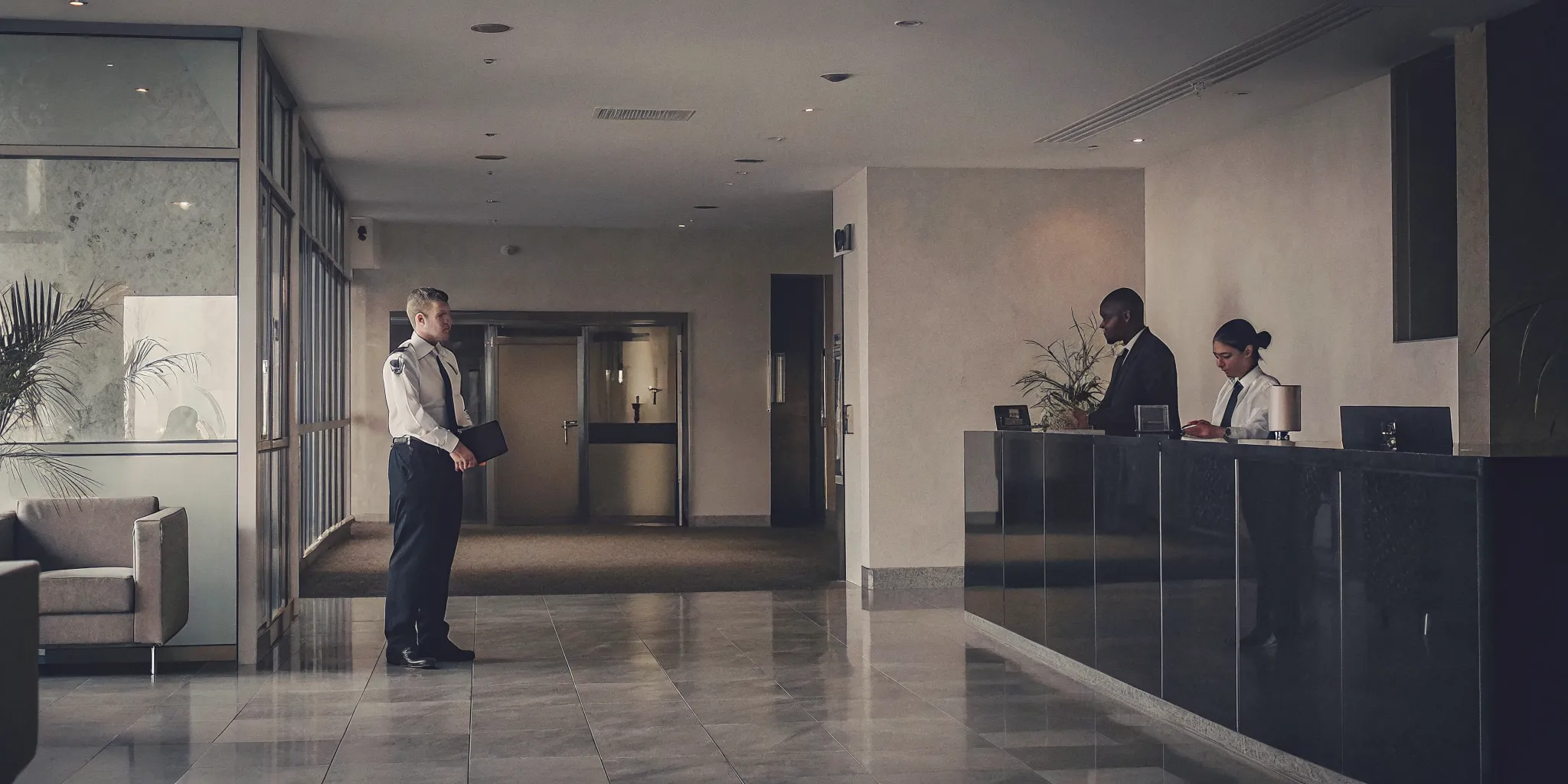
Not every workplace needs the same schedule or guard profile. Some offices need a visible guard throughout business hours. Others need coverage during opening and closing, overnight shifts, executive meetings, construction, terminations, or periods of elevated concern. A site assessment should identify the moments when people, assets, and access points face the greatest exposure.
Visitor volume exceeds the current process
If employees regularly let in guests because reception is overwhelmed, the access system is not working as designed. A guard can take ownership of verification and exceptions while reception focuses on hospitality and administrative work.
The office has after-hours activity
Employees arriving early, staying late, or working weekends may cross quiet parking and common areas with limited support. Scheduled guards or security patrol services can add visible coverage and a defined contact during those periods.
The workplace handles sensitive people, information, or assets
Professional offices, government contractors, healthcare-adjacent businesses, and firms that host public-facing meetings may need stronger entry controls. ASAP Security Guards is a GSA contract holder and federal contractor, which can be relevant for organizations that require documented procedures and accountable service delivery.
Management needs better incident visibility
A recurring problem that is not documented is difficult to solve. ASAP uses GPS-enabled daily activity reporting with time-stamped details and photos, helping authorized client contacts see that coverage occurred and understand what officers observed. This turns guard activity into information that can support operational decisions.
How to plan effective office security guard coverage
A strong plan starts before the first shift. Decision-makers should walk the site with the provider, identify access points and operating patterns, define responsibilities, and agree on communication. The result should be specific enough that an officer understands the assignment and flexible enough to address real conditions.
Map people, places, and high-risk times
List who uses the office and when: employees, visitors, executives, cleaning teams, contractors, and delivery personnel. Then map main entrances, secondary doors, loading areas, parking routes, and shared spaces. Finally, identify periods that require extra attention, such as shift changes, public meetings, layoffs, or after-hours work.
Write site-specific post orders
Post orders should answer practical questions. Who may authorize a visitor? Which entrance accepts deliveries? When should the guard call 911, contact management, or notify dispatch? What must be included in an incident report? Generic instructions leave too much room for inconsistent decisions.
Choose an appropriate guard profile and schedule
Most office assignments emphasize communication, observation, and access control. Armed coverage may be appropriate only when the risk assessment and business requirements support it. ASAP offers both armed and 24/7 security guard coverage, allowing the plan to match the environment instead of forcing every office into the same model.
Review performance with useful evidence
Evaluate more than whether an officer arrived. Review patrol completion, visitor exceptions, incident quality, response times, and repeated concerns. ASAP’s 24/7 human dispatch and GPS-enabled reporting support accountability while giving guards a live point of contact when conditions change.
Contact ASAP Security Guards to discuss a site-specific plan for reception, access control, patrols, and after-hours office coverage.
Frequently asked questions about office security guards
What duties do office security guards perform in a reception area?
Office security guards can verify visitors, contact hosts, issue credentials, manage access exceptions, monitor lobby activity, and document incidents. Their exact duties should be defined in site-specific post orders so security and reception responsibilities do not conflict.
Can office security guards help without making the lobby feel unwelcoming?
Yes. A professional guard can greet visitors and explain entry procedures while consistently enforcing boundaries. Good visitor service and effective security support each other because clear instructions reduce confusion and prevent avoidable confrontations.
Do cameras replace the need for office security guards?
Cameras provide visibility and recorded evidence, but they cannot question a visitor, stop tailgating, de-escalate a dispute, or guide employees during an emergency. A guard can monitor and act on information from cameras as part of a broader security plan.
Are office security services available for limited hours?
Coverage can be designed around business hours, after-hours operations, special meetings, temporary projects, or periods of increased concern. The right schedule depends on the site’s traffic, access points, risks, and existing security systems.
Build an office security plan around your workplace
Effective office security is not about creating friction at every door. It is about giving employees, visitors, and managers a predictable process when everything is normal and a trained response when it is not. ASAP Security Guards combines Southern California responsiveness, 24/7 human dispatch, experienced personnel, and GPS-enabled reporting for accountable commercial security.
Request a quote for office security guards or call (619) 274-1600 to discuss your workplace, schedule, and access-control needs.
