
When you think of a security guard, an outdated image of a simple watchman might come to mind. But the role of a modern security professional, especially in a school setting, has evolved dramatically. Today’s officers are trained in conflict de-escalation, emergency first response, and community engagement, serving as proactive safety experts rather than reactive enforcers. This changes the entire conversation around whether schools should have security guards. The focus shifts from simply having a uniform on campus to integrating a highly skilled specialist into your safety team. Let’s break down what a professional security officer truly brings to a school.
Security Guard For Schools: Keeping Our Children Safe
School safety has come under intense scrutiny lately, with the rise of many horrifying school shootings. Suggestions abound- Arm the teachers! Increase mental health services! Strengthen gun laws to regulate gun access! Parents, students, and teachers are rightly demanding that schools return to being places of learning and sanctuary in their communities. Many options are being examined, but schools need immediate action right now to keep their campuses safe. So is a security guard for schools the right option? Let’s dive into this topic.
What Really Works for School Safety?
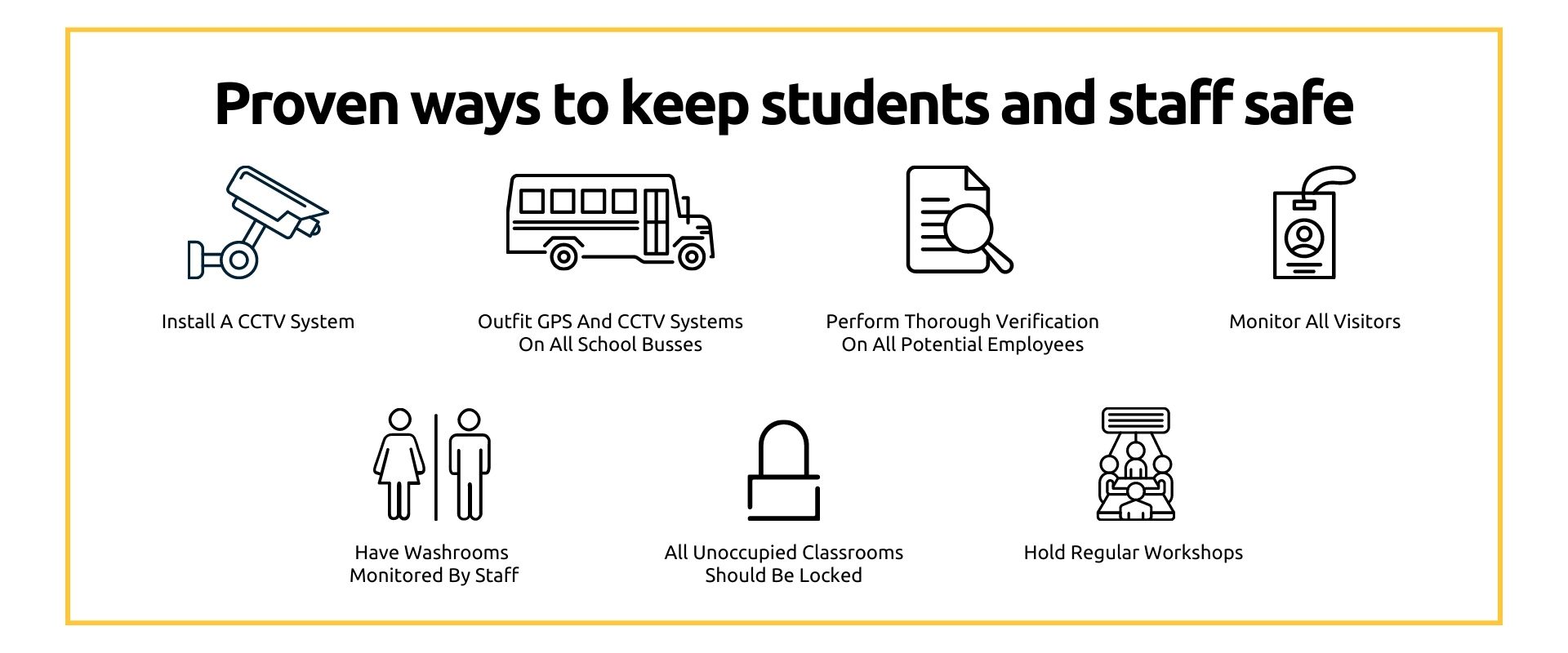
There are certain basic security factors that need to be implemented in all schools:
 1. Install A CCTV System
 1. Install A CCTV System
CCTV monitoring of school premises enhances campus safety by providing constant surveillance and deterrence against potential threats. The presence of cameras across the campus acts as a powerful deterrent, discouraging trespassers, vandals, and unauthorized individuals. Real-time monitoring allows swift identification of any security breaches, enabling immediate response and intervention, ultimately creating a secure learning environment.
2. Secure School Buses with GPS and CCTV
Equipping school buses with GPS allows school management to track children’s travels, ensuring their safe transportation to and from school. Additionally, installing CCTV cameras on board buses adds an extra layer of safety, providing real-time monitoring of student activities and ensuring proper conduct. This comprehensive approach enhances child safety during their daily commutes, promoting a secure and worry-free environment for students and parents alike.
3. Vet Every Staff Member Thoroughly
Thorough verification of all staff, including non-teaching personnel, before hiring is crucial to keeping kids safe at school. Background checks and rigorous screening processes help identify potential risks or individuals with questionable backgrounds. This ensures that only trustworthy and qualified individuals are entrusted with the safety and well-being of students, fostering a secure and nurturing educational environment.
4. Manage and Monitor Campus Visitors
Monitoring visitors carefully when entering or leaving the school premises, including verifying authorization to pick up students, is essential for ensuring kids’ safety at school. This precautionary measure prevents unauthorized individuals from gaining access to students and minimizes the risk of potential security breaches or abduction attempts. By diligently managing visitor access, staff or security personnel can create a secure environment where students’ well-being is prioritized and protected.
5. Monitor Washrooms to Prevent Bullying
Having attendants in the washrooms for safety monitoring enhances kids’ safety at school. Attendants can deter bullying, prevent vandalism, and address any emergency situations promptly. Additionally, providing separate washrooms for school management ensures a clear division of spaces and minimizes the risk of unauthorized access, promoting a secure and comfortable environment for all students.
6. Lock All Unused Classrooms
Keeping empty or unused classrooms locked at all times ensures kids’ safety at school by preventing unauthorized access and potential incidents. By maintaining strict access control, the risk of unauthorized individuals entering the premises is minimized. Additionally, the policy of not allowing any child to be alone with staff enhances protection against potential misconduct, prioritizing students’ safety and well-being.
7. Run Regular Safety Training and Workshops
Regular workshops and training sessions on safety protocols empower students, parents, and teachers to play an active role in keeping kids safe at school. By educating them on how to recognize potential threats before they occur and providing specific action plans for various situations, the school community becomes better equipped to respond effectively to emergencies. This proactive approach instills a sense of preparedness and confidence, fostering a secure and vigilant learning environment for all. These are the minimum basics of school safety that a school can put into place. However, there is one final key ingredient needed to achieve maximum school safety.
Should Schools Have Security Guards for Maximum Safety?
The final key to a successful school security program is having well-trained security officers stationed at the schools. School resource officers (SROs) who are sworn police officers, OR security officers (SSOs) from a private company, can be implemented specifically in any school community: 1. Security officers can monitor access points to the campus and verify who comes and goes. 2. Security personnel can orchestrate pedestrian and traffic safety as well as control school access. 3. Security personnel can monitor CCTV/bus cameras which exponentially increases proactive school safety. 4. Security officers of either type may be armed or unarmed, as there is still ongoing controversy surrounding the use of armed security guards at schools. The work of any type of security officer can be customized to meet the school and community’s demands. Some schools have even utilized private security workers as paraprofessionals in special education classrooms, fostering student relationships and morale. Private security companies such as ASAP Security must undergo whatever rigorous training is needed to enhance school safety to their client’s demands. In California, for instance, there is a mandated curriculum for any school security officers (https://www.bsis.ca.gov/industries/syllabus.shtml.) A professional security company such as ASAP Security would be specifically trained school security officers (SSOs) that would achieve the safety plan the client school establishes.
The Numbers Behind School Security Guards
When deciding on a security plan, it helps to look at the data and understand the perspectives of those most affected. The conversation around school security guards involves strong opinions, complex statistics, and significant financial considerations. Examining these numbers provides a clearer picture of the role guards play in our schools and the factors administrators must weigh when creating a safe learning environment for students and staff.
Public and Teacher Opinion
The feeling of safety is fundamental to a productive school. For educators on the front lines, a security presence can make a significant difference in their day-to-day experience. It’s telling that research shows more than 85% of middle and high school teachers feel safer when a security officer is on campus. This increased sense of security isn’t just about preventing a major crisis; it’s about establishing a calm and controlled environment. When teachers feel protected, they can focus their full attention on education, and that feeling of stability often extends to the entire student body, helping to reduce anxiety and build a more trusting school community.
Effectiveness in Active Shooter Situations
The role of armed guards during a worst-case scenario is a point of intense debate, and the data can be complex. For example, one study found that in a review of 133 school shootings, those with an armed guard present had, on average, more people killed. This statistic doesn’t automatically mean guards are ineffective; instead, it highlights a critical reality: the mere presence of a guard is not a complete solution. The effectiveness of any school security officer depends entirely on their training, response protocols, and ability to perform under extreme pressure. It reinforces the absolute necessity for elite, continuous training that goes far beyond basic certification.
Prevalence and Cost of School Guards
Implementing security on a broad scale is a major financial commitment. Estimates suggest that placing an armed officer in every public and private school in America could cost between $10 and $13 billion each year. For individual school districts, this is a massive expense that must be balanced against other critical needs. This financial pressure is why many administrators explore partnerships with professional security firms. A dedicated security company can often provide highly trained personnel and customized plans that are more flexible and cost-effective than hiring full-time law enforcement officers, all while maintaining the highest standards of safety and preparedness.
Beyond Deterrence: The Positive Roles of School Guards
A truly effective security officer does more than just stand watch; they become an integral part of the school community. Their role is not just about preventing worst-case scenarios but also about contributing to a positive and orderly environment every single day. From managing campus flow to being a trusted presence for students, their contributions can significantly enhance the overall school experience. A proactive guard helps build a culture of safety that allows students and educators to focus on what matters most: learning and growth.
Preventing Specific On-Campus Issues
The daily value of a security guard often lies in the incidents that *don’t* happen. By being a visible and engaged presence, they help create a positive school feeling where people worry less and trust more. An observant officer can de-escalate conflicts before they become physical, deter bullying, and ensure proper visitor protocols are followed to keep unauthorized individuals off campus. They are instrumental in maintaining a structured environment, managing access control, and reinforcing the school’s commitment to a safe and respectful atmosphere for everyone.
Serving as Emergency First Responders
In any crisis, a fast response can make all the difference. Professional security guards are trained to be the first line of defense in a wide range of emergencies, not just security threats. Many are certified in CPR and first aid, enabling them to provide immediate medical care to a student or staff member in need while waiting for paramedics to arrive. This versatility makes them an invaluable asset to any school. Whether it’s a fire alarm, a medical issue, or a security alert, a well-trained officer is equipped to manage the situation calmly and efficiently, providing a critical bridge of support when it’s needed most.
Contributing to Long-Term School Improvement
Ultimately, every aspect of a school’s operation should support its educational mission, and security is no exception. There is a direct link between safety and academic success: when students feel safe, they learn better. A secure campus reduces the chronic stress and anxiety that can hinder focus and engagement in the classroom. By providing a consistent and reliable security presence, schools create the stable foundation students need to thrive academically and socially. This commitment to safety is a long-term investment in the well-being and future success of every student.
Potential Concerns and How to Address Them
Introducing security guards into a school setting is a significant decision, and it’s natural for parents and administrators to have questions and concerns. Issues like student anxiety, the potential for over-policing, and the risks associated with having firearms on campus are all valid points that deserve careful consideration. The key to navigating these challenges lies in choosing the right security partner and implementing clear, thoughtful policies. A professional approach ensures that security enhances the learning environment rather than detracting from it.
Impact on Student Anxiety and School Climate
A primary concern is that a visible security presence, particularly an armed one, might create a punitive or intimidating atmosphere that causes student anxiety. The solution lies in the professionalism and character of the officer. The goal is to integrate a security professional who acts as a guardian, not a disciplinarian. An officer with strong communication skills who engages with students in a positive and respectful way can become a trusted, reassuring figure. By selecting a security team that emphasizes de-escalation and community-oriented approaches, a school can bolster safety without sacrificing its welcoming climate.
The Risk of Criminalizing Minor Misbehavior
Some research indicates that increased security can lead to more arrests or suspensions for minor, non-violent issues, blurring the lines between discipline and law enforcement. This is why establishing clear boundaries is critical. The role of a private security guard should be explicitly focused on safety from external and significant internal threats, not on enforcing school rules or handling routine student discipline. That responsibility should remain with teachers and administrators. This clear division of labor ensures that security officers remain neutral protectors and prevents the criminalization of typical adolescent behavior.
Accidents, Misuse, and Financial Trade-Offs
Bringing a firearm onto a school campus is a serious matter that carries inherent risks, including accidental discharge or misuse. This is precisely why the standards for an armed security guard in a school must be exceptionally high. It requires more than just a license; it demands rigorous, ongoing training in firearms proficiency, situational judgment, and decision-making under pressure—standards often met by those with former military or law enforcement backgrounds. While hiring this level of elite professional represents a significant financial investment, it is a necessary one. The cost of prevention is always less than the cost of a tragedy.
The Ongoing Debate: How to Best Use Security Guards
In light of the many recent violent campus events, the community consensus seems to be that security personnel are indeed vitally needed to maintain school safety. Still, there is ongoing debate in the school security industry on how to best use security officers at schools. School communities differ on what type of school security officers they want and how they should be used. Should schools utilize private security officers (SSOs) or police security officers (SROs)? Or some combination thereof? And should the guards be armed or unarmed? These are the questions that must be resolved to implement each school campus’ best safety plans. This is where a professional security company such as ASAP Security would play a key role and could be the most effective and affordable security for a school community.
SSO vs. SRO: Which is Right for Your School?
School Security Officers (SSOs) are private security workers from security companies (such as ASAP Security). School Resource Officers (SROs) are sworn police officers, members of the local police department, in police uniform, usually armed. Some school districts have opted to move police officers out of their schools, fearing the backlash from police violence issues (Goldstein, 2021). Those schools opt instead for privately trained security officers (SSOs), trained in laws and liabilities, student behavior dynamics, and conflict resolution with special emphasis on de-escalation techniques. SSOs do not have the same stigma as police officers, but they can still provide most of the security functions necessary for school safety. Schools must also decide if they want armed or unarmed SSOs or SROs in their school. Using armed guards can increase the feeling of security on campus and deter unwanted activity. However, the use of armed security guards- either SSOs or SROs- raises concerns about their detrimental effects on morale, or if having weapons truly does prevent school violence. Statistically, it is shown that the likelihood of someone being injured when an armed guard is present is 4 times higher. (Joffe, 2022) If armed guards are used, can lethal force be a gun, a taser, or pepper spray instead? These are variables that any school must address. As stated previously, concerns about Armed SROs on campus have risen in the light of police violence issues. Some schools have also decided against using armed police officers for their school safety plans, desiring to maintain a less-charged atmosphere on their campuses. Uniformed, armed police on campus may have an unwanted impact, especially on minority students. In addition, how the SROs are paid can be a complicated and political issue- while there are federal grants and funding available for SROs, there are still arguments over expenses coming out of the school system’s budgets as well (Starr, 2018). “For all the benefits of having armed officers in schools, things can and often do go wrong, too.” Joshua P. Starr, former school superintendent
What to Look for in a School Security Service
Choosing a security partner for a school isn’t like hiring security for a warehouse or a corporate office. The environment is unique, the stakes are incredibly high, and the community’s comfort level is paramount. The right security service understands this nuance and provides officers who are more than just a uniform; they are trained professionals equipped for the specific challenges of an educational setting. A top-tier service will offer a customized security plan that integrates seamlessly with the school’s existing culture and safety protocols, ensuring that their presence enhances the learning environment rather than detracting from it. This involves a deep understanding of access control, emergency response, and the subtle art of being a reassuring presence for students, staff, and parents.
When vetting potential security providers, it’s crucial to look beyond the basics. A truly effective school security service invests heavily in specialized training that covers conflict de-escalation, adolescent psychology, and specific procedures for school-based emergencies. They should act as a collaborative partner, working with school administration to identify vulnerabilities and strengthen the overall safety plan. This partnership includes everything from managing daily traffic flow and monitoring CCTV systems to playing an active role in emergency drills. The goal is to find a company that doesn’t just place a guard on your campus but provides a comprehensive security solution that protects, reassures, and supports your school’s mission.
Specialized Training Requirements
A security officer’s role on a school campus is multifaceted, requiring a skill set that goes far beyond basic patrol duties. Look for a service that provides training specifically for the educational environment. Officers should be experts in monitoring campus access points, verifying every person who comes and goes to ensure only authorized individuals are present. They need to be proficient in orchestrating pedestrian and vehicle traffic to maintain safety during busy drop-off and pick-up times. Furthermore, they must be skilled in using technology like CCTV systems to proactively monitor the campus, exponentially increasing the ability to spot and address potential issues before they escalate into serious incidents.
Key Questions for School Administrators
Before making a final decision, it’s vital to balance your safety goals with the needs and feelings of your community. Every school is different, and what works for one may not be right for another. Start by asking critical questions to guide your choice. How much faster could a dedicated on-site guard respond to an emergency compared to local law enforcement? For a school with a history of few safety incidents, does the presence of an armed guard provide necessary protection or create undue anxiety? It’s important to weigh the deterrent effect against the potential impact on the school’s atmosphere and what your budget can realistically support.
Considering Alternative Safety Measures
A comprehensive safety plan often involves more than just security personnel. While guards are a critical component, they are most effective as part of a layered security strategy. It’s wise to also invest in the physical security of your buildings by improving locks, reinforcing entryways, and controlling access to the campus. Beyond physical measures, focus on preventative strategies that address root causes of violence. This includes robust mental health resources for students, effective anti-bullying programs, and systems for identifying and supporting at-risk individuals. A holistic approach creates a safer environment from the inside out, making the campus a place where students can thrive.
Debunking Common Myths About School Security Guards
The conversation around school security is often filled with misconceptions. Many people picture an intimidating figure whose only job is to enforce rules and punish misbehavior. This outdated view couldn’t be further from the truth of what a modern, professional security officer brings to a campus. Today’s school security officers are trained safety experts focused on prevention, de-escalation, and emergency response. They are an integral part of the school’s team, working to build a safe and positive environment where students can focus on learning. By understanding their true role, schools can better leverage their expertise to create a campus that feels secure, supportive, and welcoming for everyone.
Myth: Their Only Job is Punishment
One of the biggest myths is that security guards are on campus simply to discipline students. In reality, their primary role is not punitive but preventative. A well-trained school security officer is a safety expert focused on identifying potential problems and de-escalating situations before they require disciplinary action. They are the first responders in an emergency, trained to protect students and staff. Their goal is to maintain a secure environment where learning can happen without disruption, acting as a resource for safety rather than an enforcer of school rules, a job best left to administrators and teachers.
Myth: They Make Schools Feel Like a Prison
Some worry that a visible security presence will create an intimidating, prison-like atmosphere. However, the opposite is often true when you have the right personnel. A professional, friendly, and well-integrated security officer can actually make a school feel safer and more positive. By building trust and positive relationships with students and staff, they become a familiar and reassuring presence on campus. Their role is to contribute to a sense of community and well-being, ensuring that the school remains a welcoming place for everyone while being a hard target for any potential threats.
Myth: They Don’t Work with School Staff
Another common misconception is that security guards operate in a silo, separate from the rest of the school’s faculty and administration. Nothing could be further from the truth for an effective security program. Security officers are a crucial part of the school’s safety team. They collaborate closely with administrators on developing and refining emergency plans, participate in safety drills, and provide valuable input during school events. They are a partner in the school’s mission, working hand-in-hand with educators to ensure daily operations run smoothly and safely for the entire community.
Take the Next Step in Protecting Your Campus
A professional security company such as ASAP Security can help a school establish the exact safety protocols that the school staff and community desire. SSOs from ASAP Security will work with the school client and tailor security plans to whatever the school community decides works. It will be the best security plan, at the most affordable price. ASAP Security has been a trusted security business in San Diego County, Riverside County, Orange County, and surrounding areas. areas, protecting businesses, gated communities, malls, banks, and special events, and providing personal security for VIPs. Our professionally trained security force is background checked and vetted, many of them with experience in the military or police as well. ASAP Security can send vehicle patrols, mobile bike patrols, or foot patrols to secure your school. ASAP Security will keep property boundaries secure and check who enters or leaves the premises, and monitor CCTV cameras for problems. ASAP Security offers trained armed or unarmed protection, scheduled or unscheduled patrols- even 24/7, day or night, weekends or holidays. ASAP Security will provide positive community interactions to employees and students, and establish a reassuring and orderly safety presence on any school campus. ASAP Security guards and staff will provide responsive customer service to your school community. Just take a look at our website, or send questions to info@asapsecurity.org. Read some informative customer testimonials from our satisfied customers. Let ASAP Security provide their best professional agents for your San Diego area school or campus- armed or unarmed, uniformed or undercover, in vehicles, on bicycles, or on foot. We are available night or day, with 24/7 service.
Have Questions? Let’s Talk About Your School’s Safety.
Get your best safety plan for the best price. Call 833-272-7247, email info@asapsecurity.org, or get a quick price quote now.
Frequently Asked Questions
What’s the real difference between a private School Security Officer (SSO) and a police School Resource Officer (SRO)? The main distinction comes down to their background and focus. An SRO is a sworn police officer who is part of the local law enforcement agency. A private SSO, on the other hand, is an employee of a security company who is specifically trained to work within a school’s unique environment. SSOs often specialize in skills like de-escalation and conflict resolution tailored to adolescents, and their role is defined entirely by the school’s safety plan, not by broader law enforcement duties.
Will having a security guard, especially an armed one, make our students and staff more anxious? This is a common and valid concern, but the outcome really depends on the person in the role. The goal is to find a professional who acts as a guardian, not an enforcer. A well-trained officer with strong communication skills becomes a trusted and reassuring part of the campus community. Instead of creating a tense atmosphere, the right security presence can actually reduce anxiety by making students and teachers feel protected and cared for.
What is the guard’s role in student discipline? A professional security officer’s role should be clearly separated from routine student discipline. Their focus is on safety and security, which means preventing unauthorized access, responding to emergencies, and de-escalating significant threats. Enforcing school rules, like dress codes or tardiness, should remain the responsibility of teachers and administrators. This clear division ensures the officer is seen as a neutral protector, not a disciplinarian.
Beyond just being a deterrent, what positive contributions can a security officer make to our school? A great security officer does much more than just stand watch. They are often trained as first responders, ready to provide immediate medical aid in an emergency. They help manage the daily flow of traffic and visitors, making arrivals and dismissals safer and more orderly. By being a visible and approachable presence, they can also build positive relationships with students, becoming a trusted adult that students feel comfortable reporting concerns to.
How can we be sure a security officer is prepared for a real emergency? This is where specialized training is non-negotiable. A qualified school security officer should have extensive training that goes far beyond a basic license. Look for a provider whose training includes active shooter response, emergency first aid and CPR, and advanced de-escalation techniques. Their preparedness comes from continuous, rigorous practice in scenarios specific to a school setting, ensuring they can act decisively and effectively under extreme pressure.
Key Takeaways
- Look beyond the uniform: Today’s school security officers are highly trained safety experts, not just rule enforcers. The right professional becomes a trusted part of your community, skilled in de-escalation and emergency response, helping to create a positive and secure atmosphere for learning.
- Define the guard’s role clearly: A successful security program depends on making intentional choices. Decide whether you need a private officer or a police resource officer, if they should be armed, and what their specific duties are, making sure to keep security separate from everyday student discipline.
- Treat security as one piece of the puzzle: A guard is a critical component, but they work best within a larger safety framework. Combine their presence with physical security upgrades, strong mental health support, and anti-bullying initiatives to build a truly safe campus from the inside out.
Related Articles
- Importance of School Security Guards in Crisis Situations
- 7 Reasons Why Schools Should Have Security Guards
- School Security Guards: Protecting Students & Schools
- The Pros and Cons of Armed Security Guards for Schools
- How Security Guards Enhance School Safety