

A gate controls entry, but it does not manage every risk inside a residential community. Tailgating, unauthorized visitors, amenity-area incidents, package theft, parking issues, and after-hours disturbances still require a coordinated response. Effective gated community security combines trained guards, purposeful patrols, clear post orders, and reporting that helps an HOA or property manager make better decisions.
Request a custom gated community security consultation from ASAP Security Guards.
This guide explains how boards and community managers can evaluate guard coverage, choose between standing posts and mobile patrols, and set reporting standards that produce visible accountability.
What Does Gated Community Security Include?
Gated community security is a layered program for controlling access, deterring unwanted activity, identifying safety issues, and responding to incidents in a private residential community. A complete program can include:
- Entry gate staffing and visitor verification
- Vehicle and foot patrols
- Monitoring of cameras, alarms, and access-control systems
- Checks of common areas, amenities, parking areas, and perimeter points
- Incident response and escalation
- Daily activity and incident reporting
- Coordination with property management and emergency services
The right mix depends on the property. A compact community with one entrance has different needs than a large development with multiple gates, recreation areas, vacant lots, and several miles of internal roads. Start with risk and operational goals rather than copying another community’s staffing plan.
Start With a Community Security Assessment
Before requesting guard-service proposals, document what the program must accomplish. Review incident history, resident complaints, gate logs, parking violations, access-control failures, and areas where visibility is poor. Walk the property at the times when problems most often occur, not only during business hours.
Map the property’s risk points
Mark every vehicle gate, pedestrian entrance, perimeter opening, clubhouse, pool, mail area, playground, parking area, utility space, and other shared facility. Note lighting problems, camera blind spots, landscaping that obstructs visibility, and locations where vehicles can wait unseen.
Define measurable security objectives
“Keep the community safe” is too broad to guide deployment. Better objectives are specific and observable, such as:
- Verify all visitors at the primary gate during designated hours
- Complete randomized checks of each amenity and parking zone
- Respond to resident calls through a defined dispatch process
- Document repeated gate malfunctions and perimeter vulnerabilities
- Provide management with photo-supported proof of completed patrols
A clear assessment allows security providers to recommend coverage that supports actual needs rather than simply quoting a generic eight-hour post.
Choose the Right Guard Coverage Model
Most gated communities use standing guards, mobile patrols, or a hybrid of both. The correct model balances continuous control at critical locations with enough movement to detect issues elsewhere.
| Coverage model | Best suited for | Primary advantage |
|---|---|---|
| Standing guard | Busy entry gates and fixed access points | Continuous visitor verification |
| Mobile patrol | Large communities with distributed risk areas | Visible, randomized checks across the property |
| Hybrid coverage | Communities needing gate control and interior patrols | Balanced access control and broader detection |
Standing guard coverage
A standing guard remains at a fixed post, usually an entry gate or lobby. This model is appropriate when visitor volume is high, entry procedures require human judgment, or the gate needs continuous observation.
Typical standing-post duties include checking visitor authorization, recording contractor access, monitoring deliveries, issuing temporary passes, observing vehicles, and contacting residents or management when an entry request does not match policy. Fixed coverage also gives residents a consistent point of contact.
Mobile patrol coverage
A mobile officer checks multiple locations on a route. Patrols can deter unwanted activity, identify maintenance and safety hazards, check amenities after closing, and create a visible presence throughout a larger property. Learn more about how security patrol services in San Diego can support distributed properties.
Patrols should be randomized within defined service windows. A perfectly predictable route can leave long, known gaps. Management should still receive verification of which locations were checked and what the officer observed.
Hybrid security coverage
A hybrid program assigns one officer to the main gate while another patrols the interior, or allows a gate officer to complete short patrols during low-volume periods when the post can be secured appropriately. Hybrid coverage often works well for communities that need both access control and regular checks of interior areas.
For a deeper comparison of deployment options, see mobile security services vs. standing guards.
Build Patrols Around Purpose, Not Just Frequency
A patrol is valuable when it has clear checkpoints, observation standards, and escalation procedures. Simply driving through the property on a fixed schedule provides limited insight.
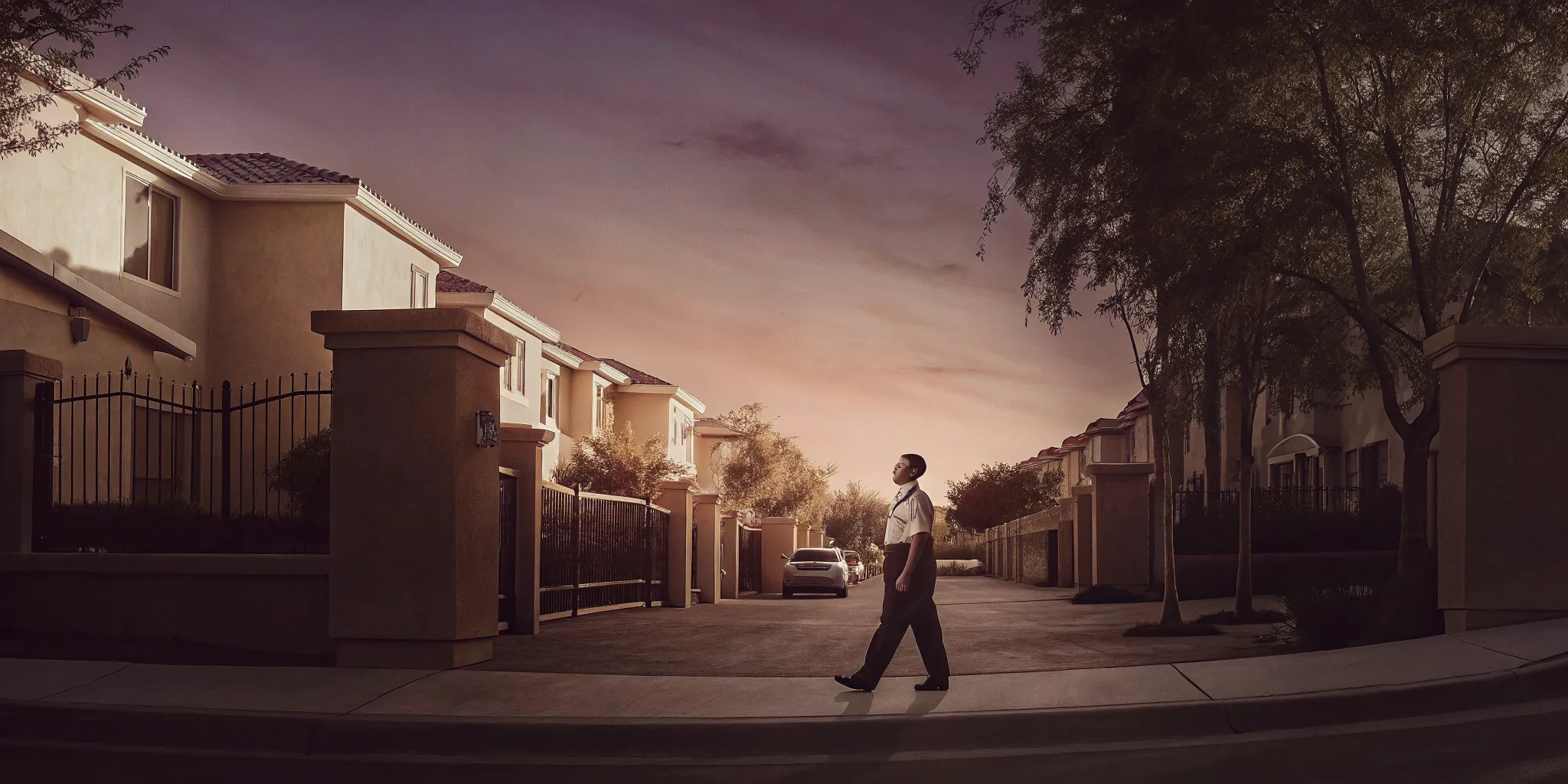
Set priority patrol zones
Divide the property into logical zones and assign priorities based on risk. For example, entry points and parking areas may need frequent checks, while a low-traffic utility area may need only one verified check per shift. Patrol instructions should identify what the officer must observe at each location.
Vary timing without losing accountability
Random timing makes patrol presence less predictable. However, “random” should not mean unverified. A reporting system should confirm that all required areas were checked within the agreed service window.
Include environmental and operational observations
Officers may be the only personnel moving through the entire community overnight. In addition to security events, post orders can require them to document open doors, damaged fencing, lighting outages, water leaks, blocked fire lanes, and access-system failures. These observations help management address conditions before they become larger problems.
Define Access-Control Procedures Before Guards Start
Gate officers need written rules that are practical, consistent, and approved by management. Without them, guards may face pressure from residents, visitors, contractors, and delivery drivers to make exceptions.
Effective access-control procedures should explain:
- How residents authorize guests
- What identification or information visitors must provide
- How recurring vendors and contractors are handled
- What happens when a resident cannot be reached
- How rideshare, food delivery, and package delivery access is managed
- Which parties may receive gate-log information
- When an issue should be escalated to management or law enforcement
Guards should enforce policy consistently and communicate professionally. The security provider and community management should also review exceptions and recurring problems so procedures can be refined.
Require Reporting That Proves Service and Supports Decisions
Reporting is the difference between assuming patrols happened and knowing what occurred on the property. A strong reporting program gives managers enough detail to verify service, identify trends, and follow up on unresolved issues.
Daily activity reports
A daily activity report, often called a DAR, records routine shift activity. It should show officer identity, shift times, patrol activity, completed checks, observations, and actions taken. ASAP Security Guards uses GPS-enabled daily activity reporting with photo documentation to provide clients with clearer proof of service.
Incident reports
An incident report documents a specific event that requires more detail than a routine log entry. It should use objective language and capture the time, location, people involved, observations, actions, notifications, and outcome. Serious incidents should be communicated immediately through the agreed escalation process rather than waiting for an end-of-shift report.
Management summaries and trend reviews
Individual reports show what happened during one shift. Periodic reviews reveal patterns. Management can use recurring observations to adjust patrol schedules, repair vulnerable areas, improve resident communication, or revise access rules. Ask prospective providers how their reports are delivered, who reviews them, and how quickly urgent issues reach decision-makers.
What Should Gated Community Security Post Orders Cover?
Post orders are the operating instructions for assigned officers. They translate the service agreement into repeatable daily actions. At minimum, gated community post orders should cover:
- Site contacts and escalation hierarchy
- Gate and visitor-processing procedures
- Patrol zones, checkpoints, and service windows
- Amenity opening and closing checks
- Parking and community-rule observation responsibilities
- Emergency procedures and limitations of authority
- Required daily activity and incident reports
- Rules for keys, access credentials, and confidential information
Post orders should be reviewed whenever the community changes a rule, adds an amenity, experiences a recurring incident, or modifies its access-control technology.
How to Evaluate a Gated Community Security Company
A proposal’s hourly rate does not reveal whether a provider can operate reliably. During evaluation, ask how the company recruits, trains, supervises, dispatches, and documents its officers.
Ask about training and supervision
Confirm that guards meet applicable licensing and training requirements and receive site-specific instruction before working independently. ASAP Security Guards operates an in-house BSIS-approved Security Academy to support professional guard development. Ask how supervisors inspect posts, address performance concerns, and keep officers current on revised procedures.
Confirm dispatch and escalation coverage
Residential incidents do not follow office hours. Determine who answers when an officer needs support, a resident reports an urgent concern, or a scheduled officer cannot report to duty. ASAP provides 24/7 live human dispatch for coordination and response.
Review reporting capabilities
Request a sample DAR and incident report. Look for useful detail rather than a list of vague entries. Confirm whether reporting can include GPS verification, timestamps, photos, and management notifications.
Evaluate fit for the community
The strongest proposal should reflect the property’s assessment, resident expectations, and operational needs. Look for a provider willing to explain the recommended deployment and adjust coverage as incident patterns or budgets change. ASAP Security Guards combines federal-contractor credentials and experienced leadership with regional Southern California responsiveness.
A Practical Checklist for Requesting a Security Proposal
Give each provider the same information so your HOA or management team can compare recommendations fairly:
- Property map, number of units, gates, and amenity areas
- Current access-control process and visitor volume
- Recent incident categories and primary concerns
- Desired service hours and required fixed posts
- Required patrol zones and approximate service windows
- Expected reporting, notification, and meeting cadence
- Known seasonal events, construction, or vendor activity
- Proposal format and decision timeline
Ask providers to separate required coverage from optional enhancements. This helps decision-makers understand tradeoffs and prevents important responsibilities from disappearing inside a broad scope.
Frequently Asked Questions
Do gated communities need security guards if they already have cameras?
Cameras can record activity and support investigations, but they do not verify every visitor, conduct physical checks, address a gate failure, or respond directly to a resident concern. Many communities use technology and guards together so alerts and observations lead to an appropriate human response.
Is a standing guard or mobile patrol better for a gated community?
A standing guard is usually better for continuous access control at a busy entry. Mobile patrols are better for checking multiple interior areas and creating a visible presence across a larger property. Communities that need both functions often use a hybrid model.
How often should security patrol a gated community?
Patrol frequency should be based on property size, risk areas, incident patterns, and service objectives. High-priority locations may require several checks per shift, while lower-risk areas need fewer. Randomized service windows with verified checkpoints are generally more useful than a fully predictable route.
What should a daily security report include?
A useful daily activity report should include officer and shift details, patrol times and locations, observations, actions taken, notifications, and unresolved follow-up items. GPS data, timestamps, and photos can provide additional proof of service.
Plan Security Coverage Around Your Community’s Risks
Reliable gated community security begins with a clear assessment and becomes effective through consistent execution. The best program gives guards specific responsibilities, gives management verifiable reporting, and gives residents a professional point of contact without creating unnecessary friction at the gate.
ASAP Security Guards designs custom residential security programs for communities across Southern California, supported by trained officers, 24/7 live dispatch, purposeful patrols, and GPS-enabled reporting. Explore our residential security guard services or request a security consultation and quote to discuss your property’s needs.
