
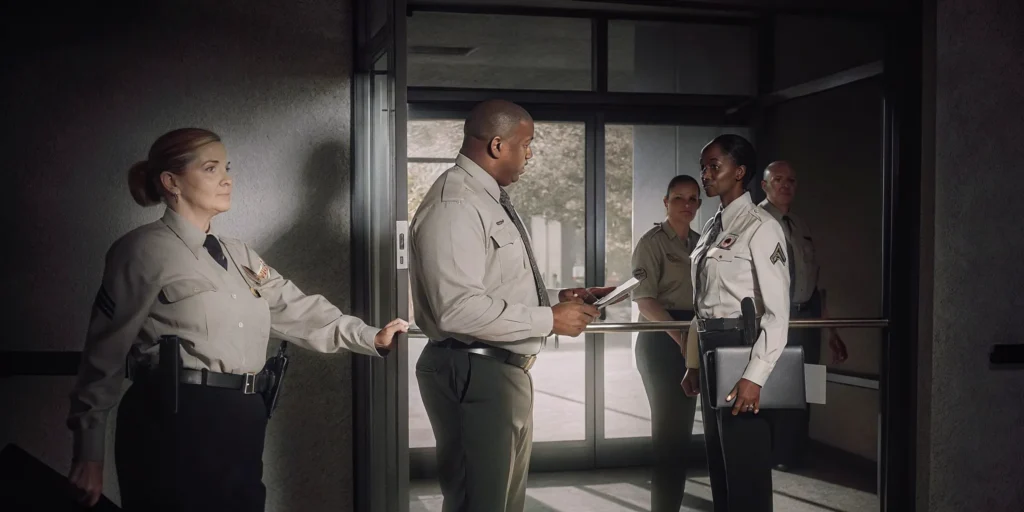
Security for a major corporate meeting in San Diego, Orange County, or Riverside demands more than locked doors and name badges. Recent data shows that 83% of Americans worry about safety at large public events, which means your attendees expect a visible, professional security presence. A well-structured event security checklist ensures your conference stays safe, compliant, and professional from start to finish.
Get Your Free Consultation: Call (833) 272-7247 to speak with an ASAP Security expert about your corporate conference security needs.
An event security checklist is the essential planning tool for corporate conference organizers in Southern California. It helps identify and eliminate safety threats before they occur. For most conferences, planners should budget at least one professional security guard for every 100 attendees to manage access points and crowd flow. Your checklist must address venue assessment, access control, emergency planning, and documentation. This ratio helps your team maintain a safe venue while ensuring that guests can move through entry points efficiently. Planners in San Diego, Orange County, and Riverside should use this comprehensive guide to build a security framework that protects people, property, and brand reputation.
Good event security begins long before the first guest arrives. A clear timeline for risk assessments, vendor coordination, and permit procurement eliminates last-minute stress. The path to a secure conference starts with proper planning.
Why Is an Event Security Checklist Essential for Corporate Conferences?
An event security checklist is essential for corporate conferences because it provides a systematic framework for identifying risks, coordinating security personnel, and ensuring compliance with local regulations. Without a checklist, critical steps like venue walkthroughs, emergency route planning, and vendor credentialing are easy to overlook. For Southern California conferences, the checklist also accounts for region-specific factors such as fire season. Earthquake preparedness, and local permitting requirements that vary across San Diego, Orange County, and Riverside municipalities.
Corporate conferences present unique security challenges that differ from public events or concerts. Attendees expect a professional environment where they can network, learn, and conduct business without safety concerns. A single security gap can disrupt an entire program and damage your organization’s reputation. The right event security checklist protects both your guests and your brand by addressing every contingency in advance.
Conferences often involve high-profile speakers, sensitive corporate discussions, and valuable technology on display. These factors make them attractive targets for unauthorized access, theft, or disruption. A thorough event security checklist accounts for each of these risk vectors and provides clear protocols for your security team to follow.
What Should Be on Your Pre-Event Security Planning Checklist?
Your pre-event security planning checklist should include venue selection and capacity verification, comprehensive risk assessments using tools like the CISA Mass Gathering guide. Security vendor vetting and contracting, local emergency service coordination, permit acquisition from city authorities, and guard deployment planning. Begin these steps at least 30 days before your conference date to allow sufficient time for vendor screening, permit processing, and contingency planning. Early planning is the foundation of effective event security.
Top-tier security for any corporate conference starts with early preparation. Beginning 30 days out gives your team the time needed to evaluate vendors, secure permits, and establish communication protocols with local emergency services.
Venue Selection and Capacity Planning
Your choice of venue directly determines the scope and complexity of your security plan. Verify that the venue’s maximum capacity aligns with your expected attendance, leaving 15% to 20% buffer space to prevent overcrowding. Large conferences can strain local resources like police and fire departments, so choose a venue with adequate exits, loading areas, and security staging space.
Conducting a Risk Assessment
A comprehensive risk assessment forms the backbone of your event security checklist. Use established frameworks such as the CISA Mass Gathering guide to identify vulnerabilities in venue layout, attendee flow, and access points. This step involves comparing event security providers to find a partner experienced in threat identification and mitigation. A thorough assessment examines venue type, event purpose, attendee profile, and local threat intelligence to build a customized protection plan.
Key risk assessment steps to include in your event security checklist:
- Determine guard-to-attendee ratio. The industry standard is one guard per 100 guests. Increase this ratio if your event serves alcohol or includes VIP attendees.
- Select a qualified security firm. Choose a provider with local knowledge, verified credentials, and proven experience. ASAP Security holds a GSA federal contract and operates a BSIS-approved training academy in San Diego.
- Coordinate with local emergency services. Notify police and EMS about your event. For conferences exceeding 1,000 attendees, request ambulance standby coverage.
- Secure required permits. Check with city authorities about event permits. Most Southern California municipalities require a signed security plan before approving permits.
- Finalize guard deployment posts. Map every guard station including entrances, loading docks, VIP areas, and exhibit halls.
Assigning Guard Responsibilities
Each member of your security team needs clearly defined duties. Some guards will verify credentials at main entrances while others patrol perimeter areas. Professional security teams use flexible staffing models to adapt coverage from a single breakout room to an entire convention center. Clear role assignments keep your conference secure and enable rapid response if an incident occurs.
Conducting a Thorough Venue Security Assessment
A venue security assessment involves walking the entire facility to identify vulnerabilities before your conference begins. This critical step of any event security checklist includes evaluating perimeter access points. Checking for camera blind spots and insufficient lighting, verifying life safety systems and fire equipment, and assessing crowd flow patterns. ASAP Security recommends conducting this assessment with your security provider at least two weeks before the event to allow time for corrective measures.
Once your initial plan is in place, the next step is a physical site walkthrough. This hands-on assessment reveals vulnerabilities that floor plans and diagrams cannot capture. A professional security team can identify risks that untrained eyes would miss.
Evaluating Perimeter and Access Points
Begin your site assessment by examining every possible entry point. This includes main entrances, service doors, loading docks, emergency exits, and any unsecured ground-floor windows. The CDC notes that mass gathering safety plans must adapt to each venue’s unique layout. So your event security checklist should address the specific configuration of your chosen facility. Use the CISA venue characteristics framework to guide your inspection of gates, fences, and locking mechanisms.
For Southern California conferences, also evaluate how the venue handles peak traffic periods. Look for bottlenecks where attendees might cluster, creating both safety risks and security screening challenges. Identifying these congestion points early allows your team to configure entry lanes and signage for optimal flow.
Identifying Camera Gaps and Blind Spots
Next, survey the venue for areas where security cameras cannot provide clear coverage. Check lighting levels in parking structures, stairwells, corridors, and near all exits. Dimly lit zones create opportunities for unauthorized activity. If camera coverage is incomplete, place security guards in those blind spots to maintain continuous observation.
ASAP Security uses GPS-tracked Daily Activity Reporting to document guard positions and patrol routes in real time. This technology ensures complete venue coverage and provides auditable proof of security presence throughout your conference. Digital documentation is a key differentiator that sets professional event security companies apart from providers still relying on paper logs.
Verifying Life Safety and Fire Systems
The final phase of your venue assessment covers emergency systems. Confirm that all exit doors open freely from the inside and that nothing blocks egress paths. Inspect fire alarms, sprinkler systems, and emergency lighting to ensure recent professional inspection and operational readiness. This part of your event security checklist directly protects lives if an evacuation becomes necessary.
Access Control and Crowd Management Strategies
Access control and crowd management form the operational core of your conference security plan. Effective access control requires credential verification at every entry point, vendor and staff gate management, and crowd flow planning to prevent dangerous congestion. For Southern California conferences, screening protocols should account for local threat levels and venue capacity. Professional security guards manage these functions while maintaining a welcoming atmosphere for attendees.

Need help designing your conference security plan? Call (833) 272-7247 for a free consultation with ASAP Security’s event security specialists.
Credential Verification at Entry Points
Security personnel should verify badges or digital tickets for every person entering the venue. This rule applies universally including speakers, sponsors, and VIPs. Consider establishing dedicated VIP lanes to keep premium attendees moving while maintaining security standards at general entry points. Professional guards can manage conference entry screening efficiently without creating excessive wait times.
Vendor and Staff Access Management
Vendors and staff typically arrive on different schedules and use different access points than attendees. Your event security checklist must include protocols for tracking vendor arrivals, verifying credentials against pre-approved manifests, and matching photo identification. Proper vendor access management prevents unauthorized individuals from entering secure areas during busy setup and teardown periods when security focus may be divided.
Crowd Flow and Screening Protocols
Large crowds can create dangerous congestion in confined spaces. Plan your floor layout to maintain steady traffic flow and avoid bottleneck areas. For high-risk conferences, consider adding bag checks or weapons screening at entry points. The CDC recommends coordinating with local health authorities to determine appropriate screening levels based on current threat assessments.
Staffing Requirements by Conference Size
Right-size your plan with professional event security guards staffing tailored to attendance, venue access points, and event risk.
The following table shows how security staffing needs change based on your conference size. Use these benchmarks to plan your budget and guard deployment.
| Conference Size | Guard Ratio | Entry Points | Screening Type | Recommended Guards |
|---|---|---|---|---|
| Small (100-500) | 1:100 | 1-2 Gates | Credential Check | 2-5 |
| Medium (500-2,500) | 1:75 | 3-5 Gates | Bag Check and ID | 7-33 |
| Large (2,500+) | 1:50 | 6+ Gates | Weapons Screening | 50+ |
How Should You Plan Emergency Response and Evacuations?
Emergency response planning for corporate conferences requires a clear command structure, coordination with local medical services, and well-marked evacuation routes. Your event security checklist should designate an incident commander, establish direct communication lines with police and fire departments. Position medical aid stations in accessible locations, and ensure all exit paths remain unobstructed. For conferences with more than 1,000 attendees, notify local EMS at least two weeks in advance to coordinate standby coverage.
Every event security checklist must prepare for the unexpected. A solid emergency plan ensures your team can handle medical incidents, fire alarms, fire season-related issues, or severe weather without panic. Effective response begins with a clear chain of command and ends with safe outcomes for every attendee.
Establishing an Incident Command Structure
Designate a central incident commander who links your security team with venue management and emergency services. This structure enables rapid decision-making when every second counts. ASAP Security’s 24/7 human dispatch center supports on-site teams with real-time coordination and resource deployment.
Communication protocols must be tested before your conference begins. Radios and phones should have dedicated emergency channels that bypass general traffic. Your incident commander must have direct authority to contact police and fire services without delay. This direct line eliminates the bottlenecks that can escalate a manageable situation into a crisis.
Coordinating with Local Medical Services
Large conferences increase the likelihood of medical incidents. For events exceeding 1,000 attendees, notify local EMS providers well in advance. This coordination ensures that emergency responders understand your venue layout and can reach any location quickly. Professional event security teams routinely manage these relationships on behalf of conference organizers.
Position medical aid stations in highly visible, accessible locations. Place them near main traffic flows but away from potential congestion points to allow rapid patient transport. Your security guards serve as first responders, guiding medical teams directly to the affected individual while maintaining order throughout the rest of the venue.
Designing Clear Evacuation Routes
Visible, well-maintained exit signage is the most critical element of emergency preparedness. Keep all evacuation paths free of equipment, crates, booth materials, or decorative elements. Distribute floor plans showing the shortest exit routes from every room and hall. When you hire conference security guards, your provider should inspect these routes multiple times throughout the event to confirm they remain clear.
Plan for personnel reserves in case an emergency extends beyond initial response capacity. Professional security firms maintain backup guards who can reach your venue within 30 minutes. This ensures continuous coverage even during extended incidents and allows primary team members to focus on attendee safety.
Technology and Documentation for Conference Security
Integrated documentation supports comprehensive corporate security solutions long after the conference ends.
Modern security technology transforms conference security from reactive observation into proactive, data-driven protection. GPS tracking, real-time Daily Activity Reporting, and live human dispatch centers provide comprehensive visibility into security operations. These tools generate auditable documentation that satisfies corporate risk management requirements and provides legal protection. For Southern California conferences, technology-enabled security teams deliver a higher standard of accountability than traditional guard services.
Modern tools elevate conference security from simple observation to data-driven operations. The right technology ensures every element of your event security checklist is followed, documented, and verifiable.
GPS Tracking and Live Reporting
Professional security teams use GPS tracking to monitor guard positions throughout the venue. This keeps personnel where they are most needed. ASAP Security’s GPS-enabled Daily Activity Reporting provides photo-verified proof of every patrol, including precise timestamps and location data. These reports show exactly when and where each guard performed their duties during your conference. Digital logs cannot be altered or lost, making them superior to traditional paper documentation for audit and liability purposes.
Live Human Dispatch and Coordination
Technology enhances human judgment rather than replacing it. A live dispatch center serves as the operational brain of your security effort. Human dispatchers maintain a complete picture of venue activity and can coordinate rapid responses during critical moments. Digital tools provide the data, but trained dispatchers make the judgment calls that keep attendees safe.
Audit-Ready Documentation
Digital records provide essential evidence for legal, insurance, and corporate compliance needs. If an incident occurs during your conference, you have time-stamped photographs, guard location data, and incident reports ready for review. This documentation demonstrates that your organization took every reasonable precaution to protect attendees.
Frequently Asked Questions
What are the 5 D’s of security for events?
The five D’s of event security are deter, detect, delay, deny, and defend. Visible security guards deter potential threats. Cameras and monitoring systems detect issues early. Physical barriers and access controls delay unauthorized entry. Security protocols deny access to restricted areas. Finally, your team must be prepared to defend the venue if an active threat occurs. This framework provides a structured approach to building your event security checklist.
How many security guards do I need for a corporate conference?
Most conference planners use a baseline ratio of one security guard for every 100 attendees. This number increases based on risk factors such as VIP presence, alcohol service, event duration, and venue complexity. Large conferences may require a 1:50 ratio with advance weapons screening. Check local regulations in San Diego, Orange County, or Riverside for any specific staffing requirements. A professional security provider like ASAP Security can help you determine the optimal guard count for your specific event.
What should a basic conference security checklist include?
A basic conference security checklist should include venue risk assessment, access control procedures, guard deployment plan, emergency response protocols, and documentation requirements. You must walk the venue to identify blind spots and verify all entry points. Confirm that your security team uses real-time reporting tools for accountability. ASAP Security recommends GPS-tracked Daily Activity Reports to provide verifiable proof of security presence throughout your event.
Why should I hire a local Southern California security company for my conference?
A local Southern California security company understands the specific permitting requirements, emergency protocols, and threat landscape of cities like San Diego, Riverside, and Orange County. Local providers maintain established relationships with area police and fire departments. They know regional risks such as wildfire evacuation procedures and earthquake preparedness. ASAP Security serves the entire Southern California region with guards who know local venues, traffic patterns, and community resources.
What credentials should I look for when hiring conference security?
Look for a security provider with BSIS licensing, verified insurance, and federal contracting credentials such as a GSA contract. Check that guards receive ongoing training through an in-house academy. ASAP Security holds GSA Contract 47QSWA21D006F and operates a BSIS-approved training academy in San Diego. The company’s guards complete continuous professional development beyond state minimum requirements. These credentials indicate a provider that meets federal standards for professionalism and reliability.
Schedule Your Southern California Conference Security Consultation
Planning a corporate conference in Southern California demands a focused approach to security that prevents costly disruptions and protects your attendees. Delaying your security arrangements can leave critical gaps in your coverage that compromise safety. By acting now, you ensure your event security checklist is complete and your team is ready for any scenario. ASAP Security helps conference organizers across San Diego, Orange County, and Riverside create comprehensive security plans tailored to their specific venue and audience.
Ready to book your consultation? Call (833) 272-7247 to speak with an ASAP Security expert and secure your corporate conference today.
