
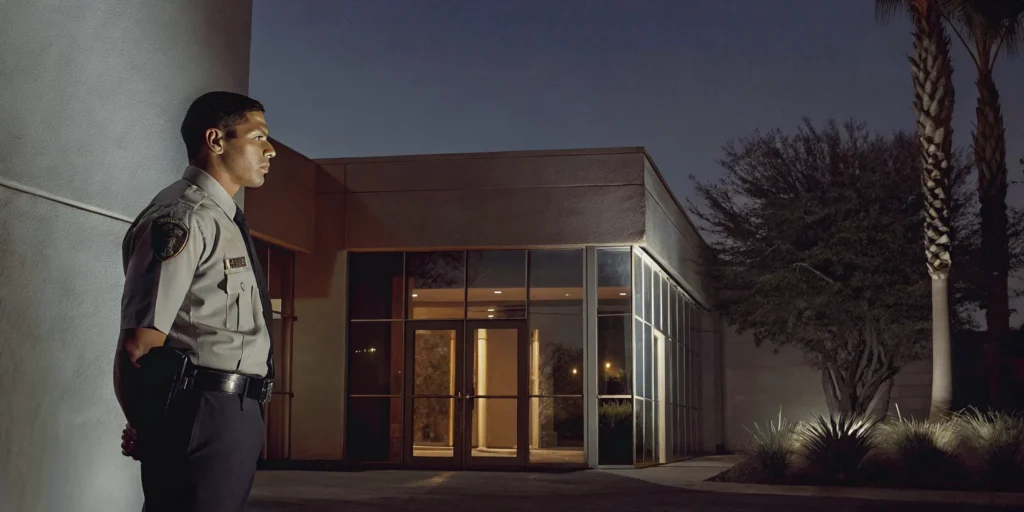
A single security gap in an office tower can lead to a million-dollar legal judgment. California law requires property owners to keep their sites safe for tenants and visitors.
Schedule your free security consultation today by calling (833) 272-7247.
Commercial building security liability is the legal duty of property owners to provide proper safety measures that protect all visitors from all likely crimes on the site. Under California law, owners must keep their premises in a safe state or face large legal claims from gaps like poor lighting, broken locks, or missing guards. Data from Liability Consultants Inc. shows that these cases often result in jury awards of nearly three million dollars for each wrongful death incident that occurs there. Fixing these gaps helps reduce money risks, keeps insurance costs low, and ensures that property managers follow the law while avoiding the high costs of legal court cases.
Property managers must know how the law views their safety choices and what duties they owe to the public. To stay protected, you should start by Understanding Premises Liability for Commercial Property Owners to build a solid defense. The path begins with
Commercial Building Security Liability: Understanding Premises Liability for Commercial Property Owners
In California, owning a business site comes with a legal duty to keep people safe. This rule is called premises liability. It means that if a guest or client gets hurt on your land because of an unsafe state, you could be held at fault. For commercial site owners, this includes keeping the building safe from crime. Failing to provide enough guards can lead to big legal costs and high insurance rates.
The Legal Duty of Care
The law starts with California Civil Code §1714. This code says that everyone is at fault for harm caused by their lack of care. For a landlord or business owner, this means you must keep your site in a safe state. You also have to warn people about any hidden risks. This duty covers many areas, such as slip and fall risks or poor lighting in a parking lot. If an owner ignores a known risk, they are often seen as negligent.
Careful care means doing what a smart person would do in the same spot. In high-crime areas, being careful might mean adding fences, bright lights, or guards. The goal is to make sure the site does not invite trouble. Courts look at whether the owner took logical steps to stop harm. If the site has broken locks or dark halls, the owner may have failed this test. These simple gaps often lead to costly legal claims.
Foreseeability of Criminal Acts
A big part of safety law is called foreseeability. This is a test to see if an owner should have known a crime might happen. Courts often look at the history of the area and the site itself. If there were many thefts or attacks nearby in the past, the law says the owner had notice of the danger. This notice means the owner must take steps to stop future crimes. It is not enough to say you did not know crime was possible.
Prior crimes on or near the site are the main way to show notice. For example, if a car was stolen from the lot last month, the owner knows there is a theft risk. Failing to add guards or cameras after a string of break-ins can lead to a lawsuit for negligent safety. Legal teams will look at police logs to see if the owner should have seen the risk coming. Keeping track of local crime is a key part of site management.
Recent Changes with SB 800
The legal landscape changed recently with the passing of SB 800 in 2023. This bill updated how courts split the fault in these cases. It explains the duties of the owner and how a jury decides who must pay for loss. Because the law is getting more hard to follow, site owners need clear proof that they took the right steps to stay safe. This proof often comes from clear logs and expert plans that show a clear effort to protect guests.
Using commercial security guard services helps an owner meet this duty of care. Guards in uniform show that you are taking active steps to protect your guests. They can watch for risks and keep notes on all that happens on your site. These notes create a trail of facts that can be used in court. Having these records is key if you ever have to defend your choices during a trial.
The Legal Consequences of Inadequate Building Security
Poor building security can lead to big legal risks for property owners. If a crime happens on your land, victims may sue you for weak security. These claims say that you failed to use proper steps to keep people safe.
Even if you win the case, the cost to defend yourself is high. Legal fees for these trials often range from $50,000 to over $250,000 per case. This high cost stays on the owner no matter the final result.
How Courts View Security Gaps
Courts look at if a crime was easy to see coming. If your building is in a high-crime area or had past issues, you must act. Failing to hire commercial security guard services can be seen as a fault.
In California, state laws like Civil Code section 1714 require owners to take care of their land. This helps prevent harm to the people who visit your site. Taking these steps shows that you are a careful owner.
Foreseeability is a key part of these legal claims. Lawyers look at past crime rates near the property to see if the owner should have known about the risk. If there were many crimes at the site before, a judge may find that you did not do enough to stop them.
High Costs of Jury Verdicts
Jury awards in these cases are often large. A study of 1,086 cases found that many end in big payouts for the victim. Only 52% of defendants won their cases, while 21% of plaintiffs won. About 8% of these cases ended in secret settlements out of court.
For instance, wrongful death cases in these trials are near $2.8 million. Robbery cases end in a mean award of $1.9 million. These facts show why local firms should use a licensed security firm to lower their risk of a lawsuit.
Costs by Business Type
Many types of firms face their own risks. Apartment owners pay a median of $1.5 million in jury awards and $1.7 million in settlements. Retail stores face even higher costs, with a median jury verdict of $1.7 million and $1.2 million in settlements.
These costs do not include the damage to your brand or the loss of tenants. Taking steps to fix security gaps now is the best way to avoid these legal debts later. Proper guards can help keep your site safe and your legal risks low.
How Security Gaps Affect Commercial Property Insurance
How Insurers Measure Your Building Risk
Insurance firms judge your property to see how likely it is that a crime will occur. They look at your past loss history and the safety steps you have in place. Fuller Insurance notes that your building place and size also play a big role in these costs. Most firms want to see that you meet the basic duty of care set by California Civil Code §1714. If you fail to keep the building safe, the insurer views you as a high risk. This means they will charge you more to cover the property.
The judging process often starts with a look at local crime rates. If your office sits in a high-crime area, the firm expects you to have more tools in place to stop theft. They check for things like strong locks, alarm systems, and clear signs. When these are missing, the firm assumes that a break-in is more likely to happen. This view of risk is the core of how they set your rates. Better safety steps show the firm that you are a careful owner who wants to avoid commercial building security liability claims.
The Financial Cost of Multiple Security Claims
When security events happen often, your claim count rises. Each new claim tells the insurance company that your building has gaps. This leads to higher monthly costs. In some cases, a firm may choose not to renew your policy at all. This leaves you with few choices for coverage. You might have to pay much higher rates to a different firm just to stay in business. The risk of being denied coverage is a major threat to your bottom line.
Claims for things like theft or assault are costly for firms. They do not just pay for the loss; they also pay for the legal work. If a guest sues you for poor safety, the firm must defend you in court. These costs add up fast. Because of this, firms track how many times people get hurt on your land. Too many events show that your safety plan is not working. The firm will then raise your rates to make up for the risk they take on by covering you.
Reducing Your Insurance Rates with Better Controls
You can lower your costs by adding the right tools. Things like on-site guards, clear lights, and cameras show that you take safety seriously. Travelers Insurance suggests that you also trim trees and keep clear visitor logs. Using trained commercial security services is one of the best ways to show you are reducing risk. This active move can lead to lower rates. It shows the firm that you have a plan to stop crimes before they start.
Good lighting and cameras are strong tools, but they work best with live guards. Having guards on the ground helps you find and stop threats in real time. This lowers the chance of a big claim that would spike your rates. You can get a free security talk to find where your gaps are today. By fixing these gaps now, you protect your tenants and your profit. A safe building is a better bet for any insurance firm.
The Hidden Financial Costs of Neglecting Security
Neglecting security can cost a commercial property owner much more than the price of a guard service. While monthly fees are clear, the costs of a security gap are often hidden until an incident occurs. These costs go beyond simple repairs and can threaten the long-term value of your building.
Direct and indirect property losses
When security fails, direct costs hit the bottom line fast. Theft of tools and goods leads to quick loss. Vandalism and damage need fast fixes. Often, these repairs cost more because they happen after hours. But the indirect costs are often larger and harder to track over time.
Business stops can cut your income for days. Handling a crime also takes up staff time. If tenants feel unsafe, they may choose to move. In fact, more than 60% of tenants say safety is a top factor when they decide to renew a lease. Losing a big tenant can cost much more than a year of professional commercial security services.
The high price of legal defense
Security gaps increase your risk of a lawsuit. Even if you win the case, the cost to fight a claim is high. Legal fees for these cases often range from $50,000 to over $250,000. These costs apply even if the court finds you are not at fault.
According to the Travelers Insurance guide on premises liability, owners must take care to keep people safe. Failing to do so can lead to big payouts. For example, jury awards for robberies average about $1.9 million. Getting a free security consultation now can help you find gaps before they turn into large bills.
Comparing prevention and response costs
The cost to stop a crime is usually much lower than the cost to fix one. Professional guard services give you a flat, known cost for your budget. In contrast, security crimes are hard to predict and cost a lot. Over time, stopping crime helps keep property value high and insurance rates low.
| Cost Category | Professional Prevention | Reactive Response |
|---|---|---|
| Daily Expense | Flat monthly contract fee | Lost staff time and quick repairs |
| Legal Risk | Proof of reasonable care | Defense costs of $50K to $250K+ |
| Tenant Impact | Higher lease renewal rates | More turnover and empty units |
| Insurance | Potential for lower rates | Risk of rate hikes or lost coverage |
| Operations | Smooth daily business flow | Expensive business stops |
How Professional Security Guards Reduce Liability Exposure
A professional guard presence is a top tool for reducing commercial security guard services liability. When building owners use trained staff, they show they take safety seriously. This step helps protect the property from costly legal claims and high insurance rates. It also creates a safer space for tenants and staff every day.
Visible deterrents stop crimes before they start
Uniformed guards act as a strong warning to people who might cause trouble. Travelers Insurance notes that having a visible guard on site is a key part of a safe property plan. A visible guard on site can cut crime rates by 30% to 50%. This drop in incidents is vital for armed security guards or unarmed staff. Fewer crimes mean fewer chances for a lawsuit to start. When thieves see a guard, they often move to an easier target.
Guards also help with commercial building security liability by watching over entry points. They check IDs and keep logs of who comes and goes. This access control keeps people who do not belong there out of the building. By stopping risks at the door, owners meet their duty to keep the area safe. This work is much better than dealing with a crime after it happens.
Accurate records protect your legal standing
If an incident does occur, having a clear paper trail is a must for your defense. Professional guards use GPS-tracked Daily Activity Reports (DAR) to log their work. These reports often include photos and time stamps that prove the guard was at their post. This data gives owners a strong shield if a tenant claims the staff was not doing their job. It turns a “he said, she said” case into a fact-based win for the owner.
Guards trained at a security officer training academy know how to record facts clearly. They act as expert witnesses who can describe what they saw in court. Their training in threat recognition helps them spot risks that others might miss. This high level of skill shows that the owner did not act with neglect. It proves that the site had a full plan to keep people safe from harm.
Rapid response limits the scale of losses
Time is a major factor when a crisis hits a commercial building. On-site guards can respond to a threat in just seconds. In contrast, police may take 15 to 30 minutes to arrive after a call. This fast action can stop a small fire, a leak, or a fight from becoming a big disaster. By acting fast, guards limit the physical damage and the risk of injury to people nearby.
Quick response also helps with insurance costs. Insurers look at how well a building handles risks when they set rates. A site with 24/7 staff is seen as a lower risk because help is always there. This can lead to lower premiums and a better deal from the insurance company. Over time, the money saved on insurance can help pay for the cost of the guard service itself.
Key Security Measures That Protect Against Legal Claims
Building owners must show they took clear steps to keep people safe. In a court of law, this is known as “reasonable care.” If a site lacks basic safety tools, the owner may face high commercial building security liability costs. Following a set plan helps lower these risks and protects your assets. A good plan uses many tools and steps to stop crime before it starts.
Perform frequent risk checks
The first step to lower your legal risk is to find where your building is weak. An expert risk check finds the gaps in your current safety plan. These checks look for issues like broken locks, dark halls, or doors that stay open. By finding these flaws early, you can fix them before a crime happens. Frequent checks prove to a judge that you were not lazy about safety. Under California Civil Code §1714, owners must keep their land in a safe state. A written record of your risk check is strong proof that you took this legal duty to heart. It shows you looked for threats and acted to stop them.
Build a layered security system
A single camera or one locked door is not enough to stop a smart thief. The best way to protect a site is to use many layers of safety at once. This method mixes tech, tools, and staff to form a solid wall. Common layers include gate controls, cameras, and guards who walk the halls. Rules for how to handle guests also play a big role in this mix. Travelers Insurance says that owners should trim tall bushes and trees to remove hiding spots. They also advise using 24/7 unarmed security services to watch the site day and night. When these layers work as one, they stop crimes and show that you tried to prevent harm to tenants.
- Use sign-in logs and badge systems for every guest who enters.
- Install bright lights in parking lots and near all side doors.
- Set up high-quality cameras at all main entry points.
- Restrict access to rooms with secret data with key cards.
- Walk all visitors to their meeting spots to keep them in sight.
- Deploy mobile security patrol to sweep parking lots, loading docks, and perimeter areas on a randomized schedule.
Focus on upkeep and training
Setting up a security plan is only the first step. You must also keep all your gear in good shape. A camera that does not record or a light that is out will not help you in a trial. Well-kept tools show that you care about safety every single day. This work includes checking alarms and testing door locks on a set schedule. It also means training your staff to follow all guest rules. Proper guest logs and badge systems help stop people who have no reason to be there. When your team knows the rules and the tools work well, you build a strong defense. This level of care can be the big difference between winning or losing a claim. High levels of care also make tenants feel safer, which can help you keep your units full for longer.
Frequently Asked Questions
What is considered negligent security for a commercial building?
Poor security happens when a land owner fails to provide enough safety steps to protect guests from known crimes. For an office building, this might include broken locks, poor lights in parking lots, or a lack of trained guards. Based on the Khalil Law Group, owners can be held liable for costs if their failure to fix these gaps leads to a crime. These cases often depend on local crime levels.
Are premises liability cases hard to win for victims?
Yes, these legal cases are often hard for victims to win. Data from a study by Liability Consultants Inc. shows that land owners won about 52 percent of cases. Victims won only 21 percent. To win, a person must show that the owner had a duty to protect them and failed to do so. They must also show the owner knew about the risks. Average jury awards for wrongful death in these cases can reach 2.8 million dollars.
What counts as foreseeable criminal activity in a liability case?
Knowing about risk is a key part of these legal cases. It is usually based on whether similar crimes happened on or near the land before. If a building is in a high crime area or has a history of break-ins, the owner should know that more crimes are likely. Courts look at police reports and local crime data to decide if the owner should have done more to prevent a certain crime from happening.
Does hiring a security service lower commercial insurance costs?
Many insurance firms offer lower costs to land owners who use early safety steps. By hiring commercial security guard services, you show a plan to lower risks that insurers value. Visible guards, gate checks, and digital logs can reduce the number of claims. This helps keep your policy active. Some firms may even ask for certain security rules as a condition for keeping your insurance coverage in place.
Ready to Secure Your Commercial Property and Avoid Legal Risks?
Leaving security gaps open can lead to costly legal fees and higher insurance rates for your business. You should not wait until after a theft happens on your property to protect your building and your staff. Acting now helps you find risks before they turn into a major loss that could hurt your company. A safe building keeps your tenants happy and protects your brand from getting a bad name in the city. Taking these steps right now makes sure your business stays on track and avoids a security loss. You can see how we protect local buildings on our commercial security services page.
Ready to schedule a free security consultation? Call (833) 272-7247 to talk to a security expert today.
